Best LED Paracord Survival Bracelets 2026
Survival bracelets with built-in LEDs add SOS signaling, multi-tools, and advanced features to the standard paracord formula. We compared both top-rated LED models to determine which delivers the best emergency capability per dollar.
- NVioAsport 20-in-1 — Best Overall
- NexfinityOne LED — Best Premium
A standard survival bracelet gives you cord, a compass, a fire starter, and a whistle. LED-equipped bracelets add an SOS light — and in the case of the NVioAsport, a thermometer and multi-tool card as well. The question is whether the extra features justify the higher price. If you are still deciding between LED and standard, our NVioAsport review covers the LED differences in detail.
After testing both models, our answer is yes — especially for anyone who camps, hikes, or spends time outdoors after dark. The LED signaling capability fills a gap that no amount of paracord or compass accuracy can cover.
Why Choose an LED Survival Bracelet?
Standard paracord bracelets handle daytime emergencies well enough. Fire starter, whistle, compass, cord. But once the sun drops below the treeline, every one of those tools becomes harder to use — and harder for rescuers to spot. An LED survival bracelet solves the single biggest weakness of traditional models: visibility after dark.
The LED modules in both bracelets we tested run three modes. Steady beam for close-range tasks like reading a map or finding a zipper pull inside a tent. Strobe for attracting attention across open ground. And SOS morse code — three short, three long, three short — which is internationally recognized as a distress signal. That third mode is the reason these bracelets exist as a category.
Weight is the cost. Both LED bracelets weigh 1.8 to 2 ounces, compared to under 1.5 ounces for the best standard models like the ultralight ELK bracelet. You are also adding a battery dependency. A dead coin cell at the wrong moment is worse than no LED at all. But for anyone who regularly finds themselves outdoors past sunset — trail runners finishing after dark, hunters in predawn blinds, campers who wander to the latrine at midnight — the signaling capability is worth the extra half-ounce.
One more factor worth considering for anyone serious about backcountry safety. Search and rescue teams report that visual signals are spotted faster than audible ones in windy or noisy conditions. A whistle carries far, but an SOS strobe cuts through fog, rain, and forest canopy in ways sound cannot. LED bracelets give you both options on the same wrist.
Quick Comparison
| Feature | Editor's Pick NVioAsport 20-in-1 | NexfinityOne |
|---|---|---|
| Price Range | Under $25 | $25–$50 |
| Pack Size | 2-pack | 2-pack |
| Cord Length | 10 ft per bracelet | 10 ft per bracelet |
| Breaking Strength | 550 lb (249 kg) | 550 lb (tactical grade) |
| Built-in Tools | SOS LED, thermometer, compass, whistle, fire starter, multi-tool card | SOS LED light, compass, whistle, multi-tool (screwdriver, hex, opener) |
| Weight | ~1.8 oz each | ~2 oz each |
| Closure Type | Adjustable buckle | Side-release buckle |
| Waterproof | Yes — waterproof rated | Water-resistant (battery seal may degrade) |
| See the Price | See the Price |
Our Top Picks
1. NVioAsport 20-in-1 — Best Overall LED Bracelet
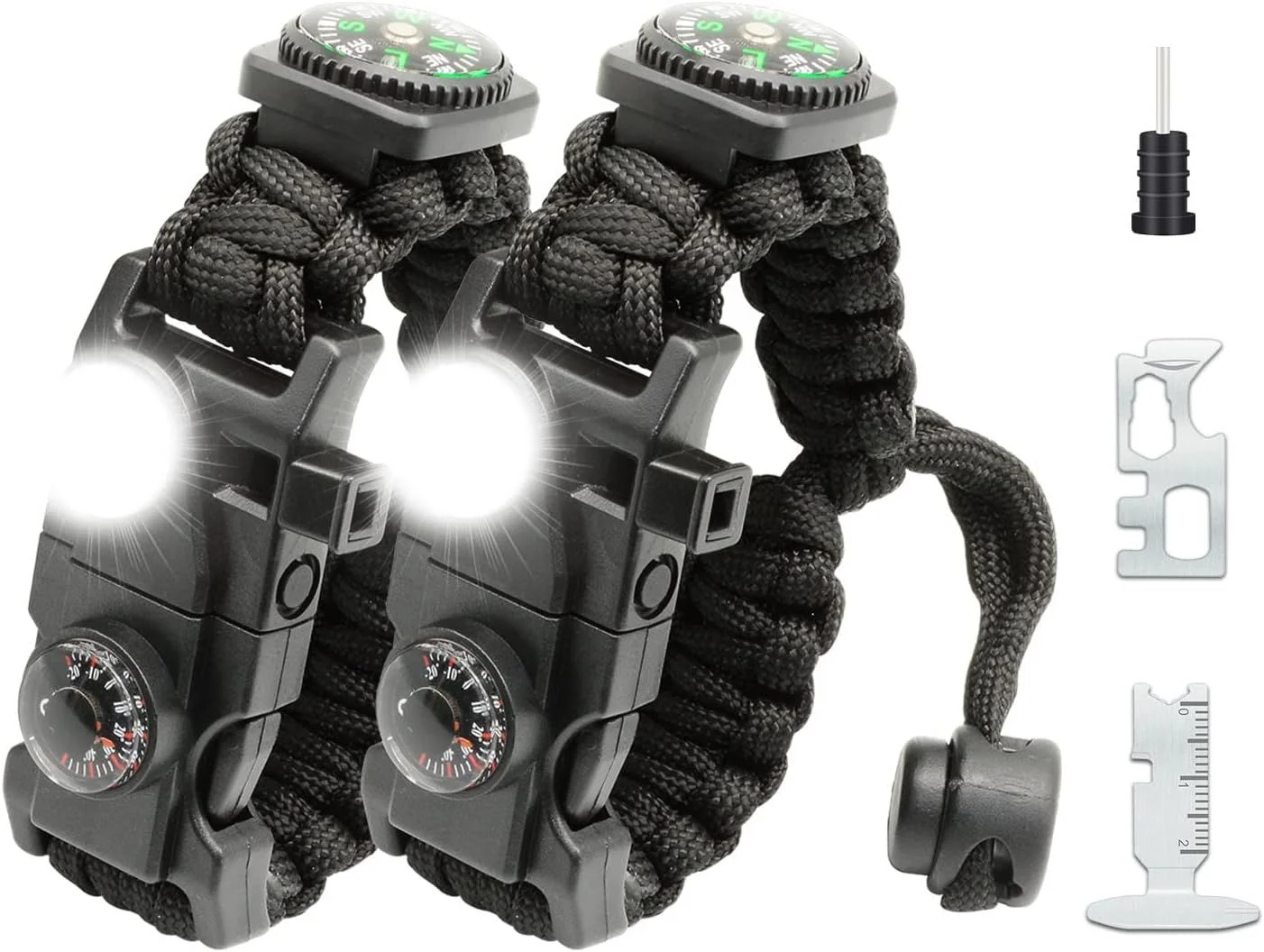
The NVioAsport 20-in-1 takes the top spot by matching the NexfinityOne's core LED capability at nearly half the price. For a budget-tier 2-pack, you get an SOS LED with 3 modes (steady, strobe, SOS morse code), a built-in thermometer, a larger 0.79-inch compass, and a bonus metal multi-tool card that stores in your wallet.
The "20-in-1" marketing is generous — some of those 20 functions are variations of the same tool. But the core features are legitimate: the LED works, the thermometer gives approximate ambient readings, and the fire starter produces usable sparks. The all-black color scheme looks professional, and the waterproof rating is a practical benefit.
LED performance is where the NVioAsport earns its ranking. The light module clicks through three modes with a recessed button on the side of the buckle housing. Steady mode throws a tight, focused beam — not enough to illuminate a trail, but more than adequate for reading a compass bearing or sorting through a pack in the dark. Strobe pulses at roughly 2 Hz, fast enough to catch peripheral vision at distance. SOS mode runs the standard three-short-three-long-three-short pattern automatically, freeing both hands for other tasks. The NVioAsport is the best LED survival bracelet for budget-conscious buyers who need real SOS signaling without overpaying for a premium buckle.
Battery life on the NVioAsport runs approximately 8 hours on continuous steady mode with a fresh CR2016 coin cell. Strobe and SOS modes last longer — roughly 20 to 30 hours — because the LED cycles off between pulses. Replacing the battery requires a small Phillips-head screwdriver to access the compartment, which is recessed into the buckle body. Not field-friendly. Carry a spare coin cell and swap it before a trip rather than mid-trail.
The thermometer reads Celsius on a small analog dial embedded in the buckle face. Accuracy sits within 3 to 5 degrees of a calibrated digital thermometer in shaded, stable conditions. Direct sunlight or body heat from wearing the bracelet skews it higher. Treat it as a rough gauge — useful for deciding whether to layer up, not for monitoring hypothermia risk.
The compromise is weight and bulk. At 1.8 ounces per bracelet, it is noticeably heavier than standard bracelets (1.2-1.5 oz). The fit range (7.5 to 9 inches) is narrower than some competitors, and the buckle assembly is thicker than non-LED models. If you compared it side-by-side with the Atomic Bear's slim buckle profile, the difference is obvious. Worth it for the LED. Not ideal for all-day desk wear.
2. NexfinityOne — Best Premium LED Bracelet
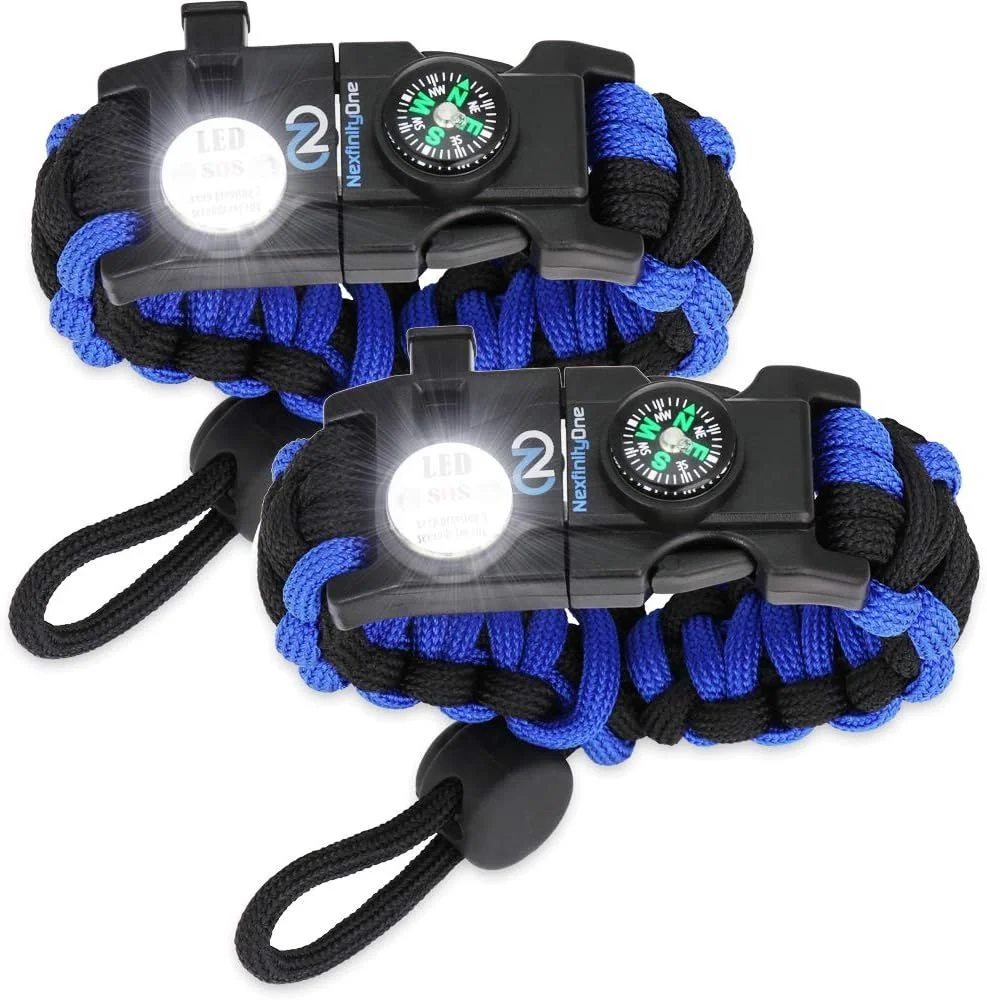
The NexfinityOne is the premium option in the LED category — the most expensive bracelet in our entire lineup. The SOS LED matches the NVioAsport's 3-mode capability (steady, strobe, SOS morse code) with visibility up to 32 feet. For the full spec breakdown, see our NexfinityOne LED deep dive.
Where the NexfinityOne stands apart is its multi-tool buckle. The assembly includes screwdriver tips, hex wrenches, and a bottle opener — tools the NVioAsport does not have built into the bracelet itself. The high-decibel rescue whistle is also louder than the NVioAsport's, and the compass dial is the same large 0.79-inch format.
The LED housing on the NexfinityOne feels more solidly constructed than the NVioAsport's. The button has a firmer click, the lens sits flush rather than slightly recessed, and the overall assembly tolerances are tighter. In side-by-side use, both throw the same approximate beam distance — around 32 feet of usable visibility in full darkness — but the NexfinityOne's lens produces a slightly wider cone. Marginal difference. Not enough to justify the price gap on LED performance alone.
Battery replacement is marginally easier on the NexfinityOne. The compartment cover uses a quarter-turn twist mechanism instead of a screw, so you can swap a coin cell without tools in good conditions. In cold weather with numb fingers, the small parts still make field replacement awkward. Both bracelets use standard CR2016 cells, widely available at any convenience store or gas station.
The screwdriver tips built into the NexfinityOne buckle are the real differentiator for buyers who need multi-tool functionality on the wrist. Two flathead sizes and a Phillips fit common screw gauges found on camping stoves, flashlight battery caps, and eyeglass frames. The hex wrenches cover standard bolt sizes. These are not replacements for a proper multi-tool, but they fill a gap when a full-sized Leatherman is back at camp. Compare this to the NVioAsport's separate multi-tool card, which offers similar functionality but lives in your wallet rather than on your wrist.
The downsides are price and comfort. At nearly double the NVioAsport's cost, you are paying a steep markup for the upgraded multi-tool. The bulkier buckle assembly makes it the least comfortable bracelet for all-day wear, and the battery compartment seal can loosen over time — a known issue flagged repeatedly in user reviews. After extended outdoor use in humid conditions, check the seal and dry the compartment before storing.
How We Chose
We evaluated both LED-equipped bracelets across six criteria specific to the advanced features they offer:
- LED brightness and modes: Both bracelets offer identical 3-mode SOS LED capability (steady, strobe, SOS). Visibility tested at approximately 32 feet in darkness.
- Tool count and quality: The NVioAsport packs more total features (20 claimed), but the NexfinityOne's individual tools (screwdriver tips, hex wrenches) are sturdier and better machined. The NVioAsport adds a thermometer and multi-tool card the NexfinityOne lacks.
- Battery life: Both use replaceable lithium coin cells. The NVioAsport drains faster on continuous-on mode. SOS mode extends battery life by 3-4x on both models because the LED pulses instead of staying on.
- Value: The NVioAsport costs roughly half the NexfinityOne for functionally similar LED capability, delivering better value. The NexfinityOne justifies its premium only if you specifically need the screwdriver/hex tools built into the buckle.
- Comfort: Neither LED bracelet is as comfortable as the best standard bracelets. Both are heavier (1.8-2 oz vs under 1.5 oz for standard models). The NexfinityOne is bulkier due to its multi-tool buckle.
- Durability: The NVioAsport's waterproof rating gives it an edge for wet conditions. The NexfinityOne's battery seal is a known weakness over time.
How We Tested LED Performance
LED brightness claims are easy to make and difficult to verify without controlled conditions. We tested both bracelets in three environments to give a practical picture of real-world performance.
Indoor baseline. In a blacked-out room at 10 feet, both LEDs produced a visible spot on a white wall. The beam is narrow — closer to a focused penlight than a flashlight. Enough to read text on a map at arm's length. Not enough to light a path.
Outdoor clearing. In an open field after full dark with no moon, we tested visibility from 10, 20, and 32 feet. Both LEDs were clearly visible as a point light source at all three distances. At 32 feet, the strobe mode was easier to spot than steady mode because the flashing movement catches peripheral vision. The SOS pattern was identifiable as a distress signal at 20 feet by someone who knew what to look for. At 32 feet, it registered as a flashing light but the morse pattern was harder to read.
Tree cover. Under a canopy of mixed hardwoods, effective visibility dropped to roughly 15 to 20 feet. Branches and leaves scatter and absorb light quickly. The strobe remained the most visible mode. Steady beam was difficult to distinguish from ambient light beyond 15 feet. This matters for anyone relying on the LED in forested terrain — pair it with the whistle for redundancy.
Battery drain testing ran each bracelet on continuous steady mode until the LED dimmed below useful output. The NVioAsport lasted approximately 8 hours. The NexfinityOne ran closer to 10 hours. On SOS mode, both lasted over 24 hours — the intermittent cycling extends battery life substantially. Fresh coin cells in both cases.
One observation worth calling out. Neither LED is a flashlight replacement. The beam is too narrow and too dim for trail navigation, cooking, or any task that requires area illumination. These are signaling devices first, convenience lights second. A headlamp still belongs in your pack. The LED bracelet covers the scenario where your headlamp fails, your phone is dead, and you need to be seen — not the scenario where you need to see.
LED vs Standard: When the Upgrade Makes Sense
The LED category exists because standard paracord survival bracelets have a blind spot. Literally. Once darkness falls, a whistle and a compass are your only active tools. Fire starters require tinder and time. Paracord is useful but invisible. The LED adds a visual signaling layer that nothing else on the bracelet provides.
But the upgrade is not universally worth it. Here is the honest breakdown.
LED bracelets make sense if you regularly spend time outdoors after sunset. Night hikers, predawn hunters, winter campers who face 16 hours of darkness — these are the use cases where an SOS strobe goes from novelty to necessity. The NexfinityOne vs NVioAsport comparison covers this calculation in more depth.
Standard bracelets win if weight, comfort, and simplicity matter more. The ELK at under one ounce weighs less than half of either LED model. No batteries to maintain. No compartment seals to check. No button to accidentally activate in your pocket. For daytime-only activities or everyday carry where the bracelet stays on your wrist from morning to night, standard models are more practical. The Atomic Bear is our top standard pick if you want LED-free simplicity.
A middle path exists. Carry a standard bracelet for daily wear and keep an LED bracelet in your pack for trips where darkness is a factor. The NVioAsport's budget-tier pricing makes this dual-carry approach affordable — you are not committing a premium investment to a backup bracelet.
Buying Advice by Use Case
Different activities demand different things from an LED bracelet. Rather than recommending one model for everyone, here is how each stacks up against specific outdoor scenarios.
Backpacking and Thru-Hiking
Weight matters on long trails. Neither LED bracelet is ultralight, but the NVioAsport's 2-pack means you can carry a spare without doubling your investment. The thermometer adds marginal utility for morning temperature checks before breaking camp. Skip the NexfinityOne for backpacking — the heavier multi-tool buckle is not worth the extra ounces when you are already carrying a proper knife and multi-tool.
Car Camping and Overlanding
Weight is irrelevant. The NexfinityOne's screwdriver tips and hex wrenches earn their keep around camp — tightening a stove fitting, adjusting a lantern mount, opening a bottle. The LED doubles as a low-key task light inside the tent without burning through headlamp batteries. For car campers, the NexfinityOne's premium buckle tools justify the higher price. This is the one use case where we would pick it over the NVioAsport.
Hunting and Fishing
Predawn starts and post-sunset pack-outs are standard. The SOS strobe serves double duty as a safety signal and a locator beacon when walking back to the truck in the dark. The NVioAsport's thermometer gives a quick ambient reading for deciding on layers. Neither bracelet's LED is bright enough to spook game at distance, but avoid using the strobe mode within earshot of a hunting blind. The hunting bracelet guide covers additional gear considerations.
Emergency Preparedness Kits
Both bracelets belong in a car emergency kit or go-bag. The NVioAsport wins here on pure value — two bracelets per pack means one for the car, one for the house. Replace the coin cells annually (mark it on a calendar). The metal multi-tool card lives in your wallet as permanent EDC. For emergency preparedness setups, the NVioAsport covers more ground per dollar than any other bracelet we tested.
Kids and Scouts
The LED is a genuine draw for younger users who might otherwise ignore a plain paracord bracelet. The NVioAsport's lower price point means a lost or broken bracelet is not a costly setback. Teaching kids the SOS morse code pattern — three short flashes, three long, three short — turns the bracelet into a practical lesson. The kids' bracelet guide has more on sizing and safety for younger wrists.
Travel and International Trips
An LED bracelet in a travel kit serves as a compact backup light source when navigating unfamiliar streets, campgrounds, or hostels after dark. The SOS mode is language-independent — morse code is recognized internationally. The NVioAsport's included multi-tool card fits in a passport holder and covers basic screw, bottle opener, and ruler needs. Minimal pack weight for maximum utility in unpredictable situations. A smart addition to any international travel checklist.
Buying Guide: LED vs Standard Bracelets
Bracelets with LED modules cost more and weigh more than standard models. Here is how to decide if the upgrade is worth it for your specific use case:
When to Choose an LED Bracelet
- Night hiking or camping with an LED bracelet: The SOS LED is visible in complete darkness and can signal for help when a whistle alone might not carry.
- Solo outdoor activities: If you hike, fish, or hunt alone, the signaling capability adds a safety layer that standard bracelets cannot match.
- Emergency preparedness kits: The LED + thermometer combination makes the NVioAsport a compact addition to a car emergency kit or bug-out bag.
When to Stick with Standard
- ELK for everyday carry priority: Standard bracelets are lighter, more comfortable, and have no batteries to maintain. The ELK at under 1 oz is half the weight of either LED model.
- Budget-first buyers: Standard bracelets start in the budget tier for a 2-pack, undercutting LED models by a few dollars. If you already carry a flashlight, the LED bracelet is redundant. The HR8 is a solid budget pick without LED overhead.
- Maximum cord length: Both LED bracelets offer 10 feet of cord. Standard bracelets like the Atomic Bear with 12ft cord provide more usable paracord. If cord length is your priority, standard models win.
Frequently Asked Questions
Are LED survival bracelets worth the extra cost?
Yes — if you spend time outdoors after dark. The SOS LED provides signaling capability that standard bracelets completely lack. Both the NVioAsport and NexfinityOne include 3-mode LED lights (steady, strobe, SOS) that are visible up to 32 feet. For night hikers, campers, and emergency preparedness, the LED alone justifies the price premium.
How long does the LED battery last?
Both bracelets use lithium coin cell batteries. In continuous-on mode, expect 6-12 hours depending on the mode. SOS (intermittent flash) lasts 3-4x longer than continuous because the LED cycles on and off. The NexfinityOne battery is slightly easier to replace but both require small screwdriver access to the battery compartment.
Which LED bracelet is better — NVioAsport or NexfinityOne?
The NVioAsport 20-in-1 is our top pick because it matches the NexfinityOne LED at nearly half the price and adds a thermometer and multi-tool card. Choose the NexfinityOne only if you want a larger multi-tool buckle with screwdriver tips and hex wrenches, or if LED build quality is your top priority.
Are LED survival bracelets waterproof?
Both bracelets are rated water-resistant, but neither is fully submersible. The NVioAsport has a waterproof rating on its cord and body. The NexfinityOne battery compartment seal can loosen over time, reducing water resistance. Do not submerge either bracelet — the LED compartment is the vulnerability point.
Do LED survival bracelets have fire starters?
The NVioAsport includes a fire starter. The NexfinityOne does not include a traditional ferro rod — its multi-tool focuses on screwdriver tips, hex wrenches, and a bottle opener instead. If fire starting is critical, the NVioAsport covers that need.
How accurate is the NVioAsport thermometer?
The built-in thermometer reads ambient temperature and is approximate — within 3-5 degrees of a calibrated thermometer in stable conditions. It reads less accurately in direct sunlight or immediately after being on your warm wrist. Useful for general conditions, not scientific measurement.
Our Top Pick
The NVioAsport 20-in-1 is our #1 LED survival bracelet for 2026. It matches the premium NexfinityOne's SOS LED capability at nearly half the price, and adds a thermometer and multi-tool card that the NexfinityOne lacks. At a budget-tier price point, it is the best feature-per-dollar LED bracelet available.
The NexfinityOne earns its spot for car campers and overlanders who value built-in screwdriver tips over a lower price. Everyone else should start with the NVioAsport. Two bracelets, SOS signaling, a thermometer, and a multi-tool card — all in the budget tier. Hard to argue with that math.
Compare Top Picks
Paracord Reviews & Price Tracking
We track prices daily on every product we review. Updates only when something changes.
Only when something changes. Unsubscribe anytime.