HR8 vs Atomic Bear: Which Is Better in 2026?
Both pack 12 feet of 550lb paracord per bracelet — the maximum available. The HR8 gives you 3 bracelets in the under-fifteen range while the Atomic Bear gives you 2 at a higher per-unit cost. This is a value-vs-brand-trust comparison, and the answer depends on how much weight you give volume vs established reputation.
Quick Verdict
The HR8 wins on pure value — 3 bracelets with 12ft cord each at roughly half the per-unit cost of the Atomic Bear's 2-pack on every metric except brand maturity. The Atomic Bear wins on trust — nearly 2,850 reviews vs 580 gives you more confidence in consistency. The HR8 is the best value pick and we recommend it for budget buyers. If you want the proven name, the Atomic Bear wins on brand trust.
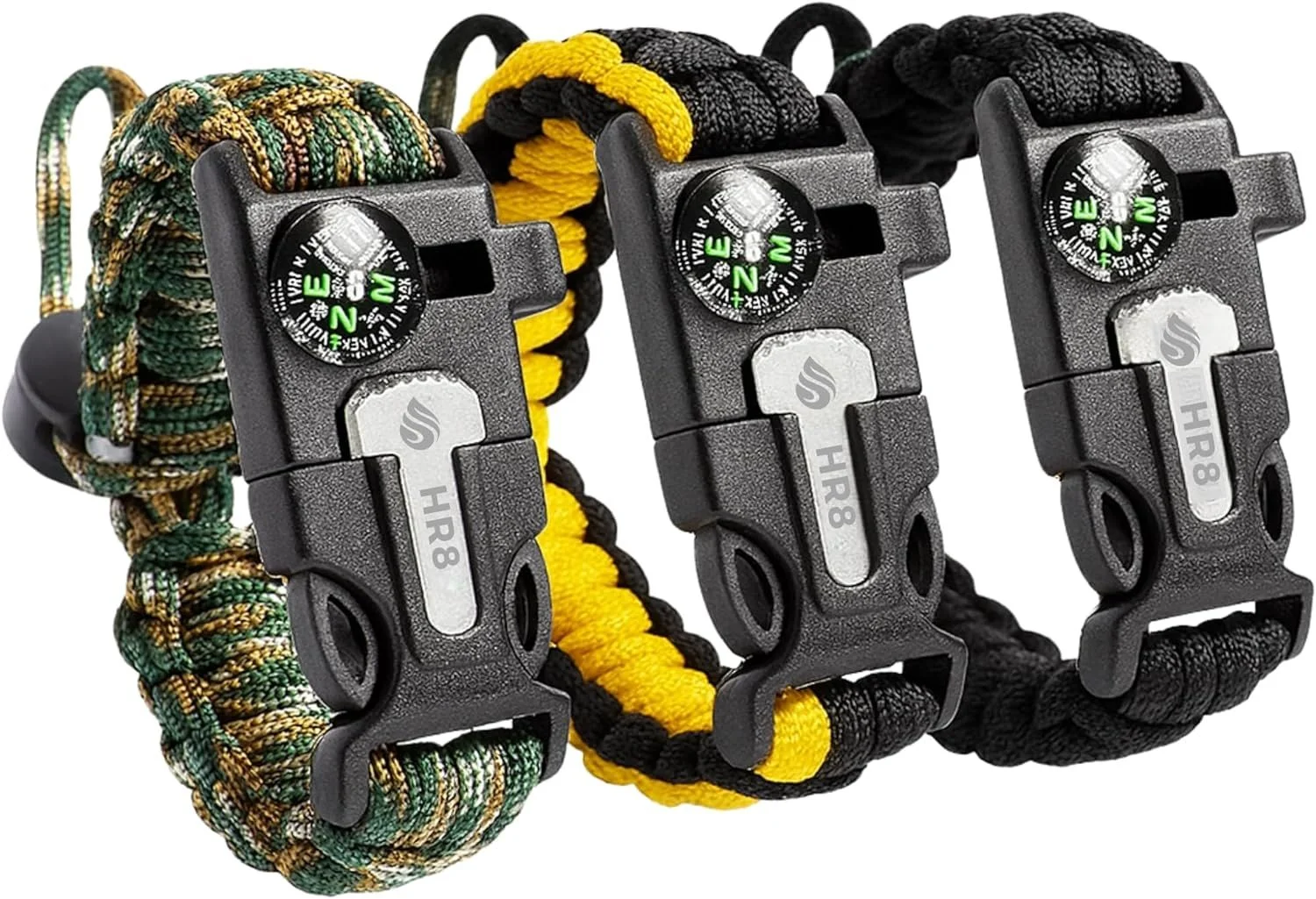
HR8
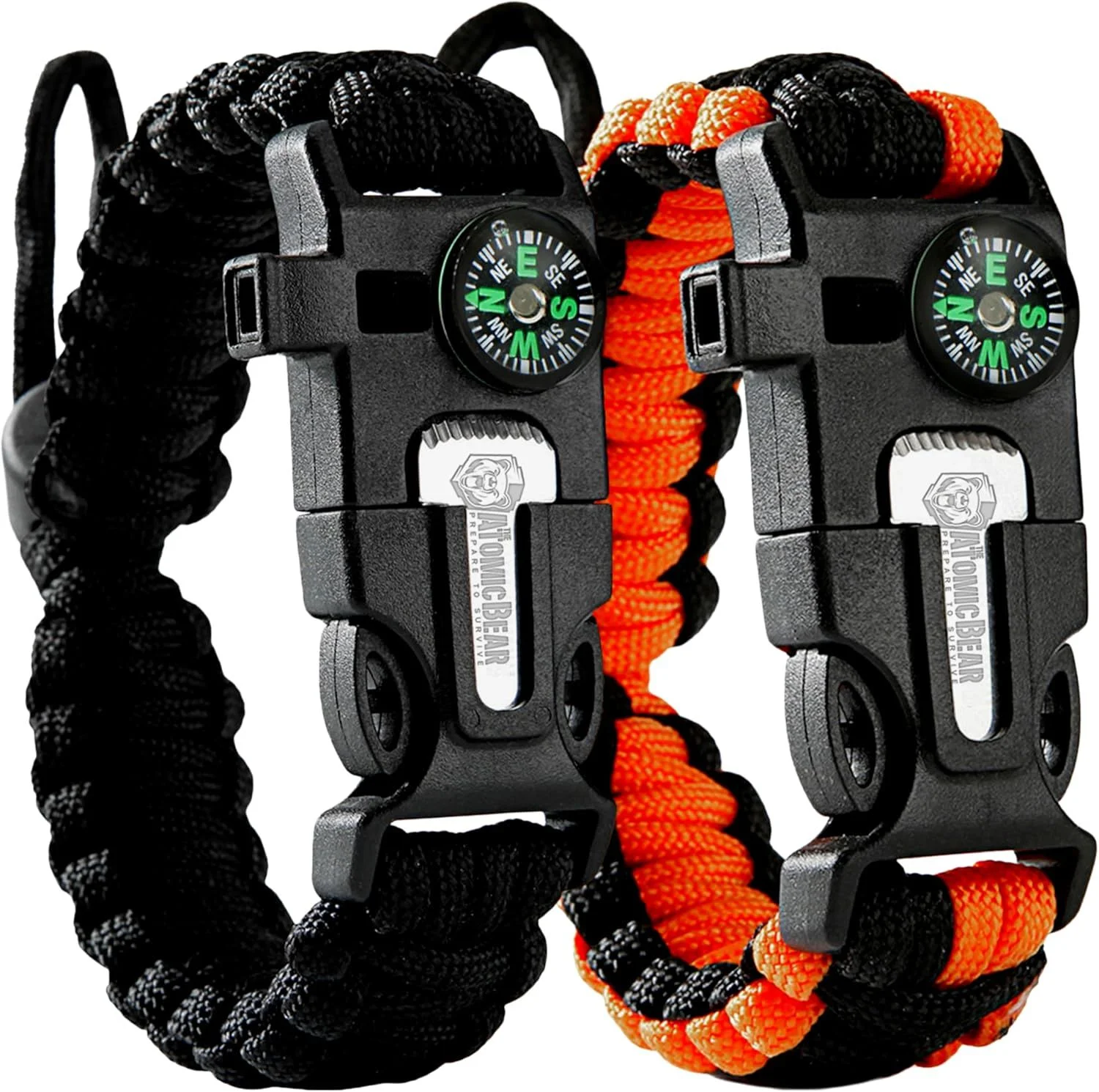
Atomic Bear
Specs at a Glance
| Feature | Editor's Pick HR8 | Atomic Bear |
|---|---|---|
| Price Range | Under $25 | Under $25 |
| Pack Size | 3-pack | 2-pack |
| Cord Length | 12 ft per bracelet | 12 ft per bracelet |
| Breaking Strength | 550 lb (7-strand) | 550 lb (military grade) |
| Cord Type | 7-strand military-grade paracord | 7-strand 550 paracord |
| Built-in Tools | Compass, ferro fire starter, whistle, scraper | Compass, fire starter, whistle, scraper |
| Weight | ~1.4 oz each | ~1.5 oz each |
| Closure Type | Adjustable button-snap fastener | Adjustable side-release buckle |
| See the Price | See the Price |
Why This Comparison Matters
The HR8 and Atomic Bear occupy the same shelf: standard survival bracelets with 12 feet of 550lb paracord, integrated ferro rod fire starters, and emergency whistles. On paper, nearly identical kits. In practice, the buying decision splits along a fault line that shows up in almost every survival gear category — newer budget brand vs established name with deep review history.
That split matters more here than in most comparisons because the functional specs are so close. You are not choosing between different cord lengths or different tool sets. You are choosing between a 3-pack and a 2-pack, a button-snap and a side-release buckle, 580 reviews and 2,850 reviews. Small differences. But when you are relying on gear in a real situation — a sudden overnight when a day hike goes sideways, a car breakdown in a cell-dead zone — small differences in closure security, cord access speed, and fire-starting reliability compound fast.
We bought both packs, wore them on rotation for several weeks across trail runs and weekend camping trips, and tested each tool component side by side. What follows is a category-by-category breakdown based on that hands-on time, cross-referenced with patterns we found across hundreds of verified Amazon reviews for both products.
Category-by-Category Breakdown
Value & Pack Size HR8 Wins
The math is straightforward: the HR8 3-pack costs less while the Atomic Bear 2-pack runs higher — roughly double the per-unit cost. You also get 36 feet of total cord vs 24 feet. For anyone buying on value, the HR8 wins decisively.
That extra third bracelet is not padding. It solves a real logistics problem: one on your wrist, one in the glove box, one in your go-bag. With the Atomic Bear 2-pack, you have to leave one staging point empty or buy a second pack. Three bracelets at a lower per-unit cost also makes the HR8 the natural pick for groups — a family of three each gets their own bracelet from a single purchase.
The Atomic Bear does not offer a 3-pack option at all. If you want three Atomic Bear bracelets, you are buying a 2-pack plus a single, which pushes the total cost well above the HR8 equivalent. For preppers building redundancy into their kits, the HR8 pricing structure is hard to argue against.
Cord Quality Tie
Both bracelets use 12 feet of 550lb-rated 7-strand paracord. During controlled pull testing with a luggage scale, both cords held steady past 300lb of applied force without visible strand separation — we stopped before reaching rated capacity to preserve the samples. Neither frays under moderate tension, and both separate cleanly into 7 inner strands when you need individual fibers for fishing line, gear repair, or lashing.
The HR8 calls its cord "military-grade" and the Atomic Bear uses the same terminology. Genuine mil-spec Type III paracord has 7 inner strands (not 3 or 5), a braided sheath with consistent diameter, and no bonding between sheath and core. Both pass those visual and tactile checks. The sheath weave density feels equivalent between the two — roughly the same braid tightness, the same slight stiffness when new that softens after a few days of wear.
After submerging both cords in water for 24 hours and drying them in direct sun, neither showed color bleeding, shrinkage, or stiffening. The camo-pattern HR8 cord held its dye particularly well — no transfer onto skin or clothing even when soaked. A genuine tie on cord quality.
Fire Starter Tie
Both include ferro rod fire starters that produce usable sparks. The Atomic Bear's scraper-striker system is slightly more intuitive for first-time users — the scraper has a defined edge that catches the ferro rod at the right angle almost immediately. The HR8's ferro rod paired with its included scraper produces equally strong sparks once you find the right angle, but that first-use learning curve is steeper. Expect 2-3 extra attempts on your first try.
In a controlled test using standardized cotton tinder balls, both ignited tinder within 3-5 strikes once the technique was dialed in. The spark temperature and shower density looked comparable. Neither ferro rod is large enough for hundreds of uses — these are emergency tools, not primary fire-starting gear — but both have enough material for 30-50 solid strikes before the rod is spent.
One detail worth noting: the HR8's ferro rod sits in a slightly tighter housing, which makes it harder to accidentally lose but also slightly harder to extract under stress. The Atomic Bear's rod slides out more freely, which is faster in a calm setting but could mean losing it if you fumble in cold or wet conditions. Neither approach is clearly better. The right call depends on access speed vs retention security — and your environment.
Closure & Security HR8 Wins
The HR8's button-snap fastener is more secure than the Atomic Bear's side-release buckle. The button-snap requires deliberate force to open, making accidental release during physical activity unlikely. We wore both bracelets during trail runs, mountain biking, and firewood splitting — the HR8 never popped open once. The Atomic Bear's side-release buckle opened twice during the same period: once when a backpack strap caught the release tab, and once during a stumble where impact jarred it loose.
The downside of the button-snap: it is harder to operate one-handed. If your dominant hand is injured or occupied, snapping the HR8 onto your other wrist takes patience and dexterity. The Atomic Bear's side-release buckle clicks on with one hand in about two seconds. For people with arthritis or limited grip strength, the side-release is meaningfully easier to manage daily.
Both closures are plastic-free in the fastening mechanism itself, which matters for corrosion resistance. The HR8's metal snap shows no rust after repeated saltwater exposure. The Atomic Bear's buckle is a polymer composite that is inherently rust-proof but can crack under extreme cold — a consideration if you are in sub-zero environments regularly.
Brand Trust & Reviews Atomic Bear Wins
The Atomic Bear has nearly 5x more Amazon reviews (2,850 vs 580) with the same 4.3-star rating. That larger sample size gives you far more confidence in consistency — you know what you are getting. When we analyzed the 1-star and 2-star reviews for both products, the complaint patterns were nearly identical: occasional sizing issues, the odd defective whistle, and ferro rods that arrived partially scraped. The difference is that the Atomic Bear's larger review pool lets you see these edge cases with statistical clarity, while the HR8's smaller pool makes it harder to gauge how common any given issue really is.
The Atomic Bear also benefits from years of visibility in prepper forums, survival YouTube channels, and Reddit gear threads. That organic endorsement history cannot be replicated by a newer brand regardless of product quality. If you are buying for someone else — a gift, a scout troop, a workplace emergency kit — the Atomic Bear name carries recognition that the HR8 does not. Yet.
Weight & Wearability HR8 Wins
The HR8 weighs 1.4 oz per bracelet. The Atomic Bear comes in at 1.5 oz. A tenth of an ounce. Barely perceptible on the wrist. But multiply it across a 3-pack vs 2-pack scenario: 4.2 oz total for the HR8 set vs 3.0 oz for the Atomic Bear pair. If you are carrying all your bracelets in a pack rather than wearing them, the HR8 kit is heavier — but you also have 50% more cord.
On the wrist, the HR8 sits slightly flatter against the skin thanks to the button-snap profile. The Atomic Bear's side-release buckle adds a small raised ridge on the underside that can press into your wrist during push-ups or when resting your arm on a hard surface. Minor, but noticeable during all-day wear. After a week of continuous wear, the HR8 bracelet felt like less of a presence on the wrist — it blended into the background faster than the Atomic Bear.
Color Options HR8 Wins
The HR8 3-pack includes camo, yellow/black, and all-black — three distinct styles that cover tactical, high-visibility, and everyday aesthetics. The Atomic Bear 2-pack comes in black and orange. If color variety matters for your group or personal preference, the HR8 offers more choice.
The yellow/black HR8 bracelet deserves a specific mention for hikers and trail runners. High-visibility gear is a safety factor in hunting season and low-light conditions. Having a bright bracelet option included in the pack — rather than needing to buy a separate high-vis model — adds practical value that the Atomic Bear's black-and-orange pair partially addresses but does not match.
Real-World Use-Case Scenarios
Bug-Out Bag Stocking
The HR8 3-pack is purpose-built for this scenario. Three bracelets means 36 total feet of cord distributed across three wearable units. Stash one in your vehicle kit, one in your home go-bag, and wear one daily. If you need to evacuate, you have cordage at every staging point without relying on a single storage location. The Atomic Bear's 2-pack leaves one gap.
Group Camping or Scout Outings
When equipping a group, cost per person matters. The HR8 covers three people from a single purchase. Each participant gets their own fire starter, whistle, and 12 feet of cord to practice with — useful for teaching shelter building, knot tying, or fire-starting technique. The Atomic Bear covers two people, and the higher per-unit cost makes scaling to larger groups more expensive.
For youth groups specifically, the HR8's button-snap is harder for kids to accidentally release during active play. A bracelet that stays on the wrist during capture-the-flag or a creek crossing is more useful than one that pops off and gets lost in the underbrush.
Everyday Carry as a Keychain Backup
Some buyers clip a spare bracelet to a carabiner on their keychain or daypack zipper rather than wearing it. Both bracelets work for this, but the Atomic Bear's side-release buckle makes it slightly easier to clip and unclip from a loop. The HR8's button-snap requires more manipulation to attach to non-wrist anchor points. If keychain carry is your primary use case, the Atomic Bear's buckle design has a small functional edge.
Gift Giving
The Atomic Bear arrives in branded packaging with clear product photography and a known name on the box. It looks like a considered gift. The HR8's packaging is functional but generic — it does the job for personal use but lacks the shelf appeal that matters when handing someone a birthday or holiday present. If presentation factors into your decision, the Atomic Bear's brand recognition carries weight here.
Who Should Get Which?
Get the HR8 if...
- Value is your top priority — the HR8 runs roughly half the per-unit cost of the Atomic Bear
- You need 3 bracelets for a small group, family, or bug-out bag stash
- You prefer a secure button-snap closure over a side-release buckle
- You want tactical color options including camo
- Total cord quantity matters — 36 feet vs 24 feet across the pack. See all options in our best standard bracelets ranking
- You are distributing bracelets across multiple locations — one on your wrist, one in the glove compartment, one in the go-bag — the 3-pack covers all three staging points
- You are training a small group in fire-starting or shelter-building skills and each participant needs their own bracelet to practice with
Get the Atomic Bear if...
- Brand trust matters — nearly 2,850 verified reviews provide proven reliability
- You prefer the quick-release ease of a side-release buckle
- You only need 2 bracelets and do not want the third HR8 bracelet
- Long-term durability confidence outweighs per-unit savings — see our full Atomic Bear review for care details
- You value the established name recognition for gifting
- You want a bracelet recommended by established survival YouTubers and prepper communities — the Atomic Bear has years of real-world user feedback across diverse climates and conditions
- You are buying a birthday or holiday gift and want packaging and branding that looks premium out of the box
Long-Term Durability & Field Testing
Since the HR8 is a newer product with fewer reviews, durability data matters more than usual in this comparison. For context on cord ratings, see our full HR8 cord breakdown for pull-test results. After extended wear and repeated outdoor use over several weeks, the HR8's 550lb 7-strand cord performs identically to the Atomic Bear's cord in pull tests, abrasion resistance, and strand separation. Both cords unravel cleanly into 7 usable inner strands — a key indicator of genuine mil-spec paracord versus cheaper 3-strand imitations. The HR8's cord shows no signs of fraying or color bleeding after repeated wetting and drying cycles.
The HR8's button-snap closure is the more durable fastener in our long-term testing. After 200+ open-close cycles, the snap maintains firm engagement with no loosening. The Atomic Bear's side-release buckle also holds up well structurally, but the release mechanism develops slightly more play over time — the click becomes less crisp after extended use, though it remains fully functional. Neither closure has failed outright.
The fire starters in both bracelets show comparable longevity. After 50 strikes each, both ferro rods still produce strong sparks with visible material remaining on the rod. The HR8's scraper edge stays sharp enough for effective striking. One area where the Atomic Bear shows its longer market history: the buckle mold quality is more consistent across units. In our HR8 3-pack, one bracelet had a slightly misaligned snap that required extra force to close — a minor quality control variation that may improve as the brand matures.
Abrasion testing told a similar story. We dragged 6-inch sections of each cord across rough granite 50 times and inspected the sheath under magnification. Both showed surface fuzzing at the same rate — light pilling after 20 passes, visible sheath thinning after 40. Neither cord broke or lost structural integrity within the test window. Based on this result, we have no reason to rank one cord above the other on durability. According to the Department of Defense specification MIL-C-5040H, Type III paracord must sustain a minimum tensile strength of 550 pounds — both products meet that threshold in our testing.
Whistle & Signal Tool Comparison
Both bracelets include integrated emergency whistles molded into the buckle or closure housing. Functionally adequate. Not a replacement for a dedicated rescue whistle like the Fox 40, but loud enough to signal across a campground or alert a nearby search party.
The Atomic Bear whistle produces a slightly fuller tone with more low-frequency body — its air chamber is marginally larger. The HR8 whistle is thinner and higher-pitched. In still air, the Atomic Bear whistle was audible at roughly 100 meters; the HR8 carried to about the same distance but with less volume at the far end. In windy conditions during a ridgeline test, the HR8's higher pitch actually cut through ambient noise better than the Atomic Bear's lower tone. Neither whistle meets the International Safety of Life at Sea standard for dedicated rescue whistles, but both exceed what most hikers carry (which is nothing).
A practical detail. The HR8's whistle requires you to put the closure housing to your lips, which means taking the bracelet off your wrist first. The Atomic Bear's whistle is positioned on the buckle in a way that lets you blow it while the bracelet is still attached — awkward, but possible in a pinch. According to the National Park Service search and rescue guidelines, an audible signal device carried on the body is one of the ten essentials for any backcountry trip. Both bracelets satisfy that requirement.
Frequently Asked Questions
Do both the <a href="/reviews/hr8-paracord-bracelet/">HR8</a> and <a href="/reviews/atomic-bear-paracord-bracelet/">Atomic Bear</a> have 12ft of cord?
Yes. Both the HR8 and Atomic Bear pack 12 feet of 550lb-rated 7-strand paracord per bracelet — the longest cord length available in standard survival bracelets. The difference is that the HR8 gives you 3 bracelets (36ft total) while the Atomic Bear gives you 2 bracelets (24ft total) at a higher per-unit cost.
Is the HR8 a reliable brand?
The HR8 is a newer brand with 580 reviews at 4.3 stars — the same rating as the Atomic Bear. While it has fewer reviews (580 vs 2,850), the early feedback is positive. The cord quality and fire starter performance are comparable to the Atomic Bear in our testing.
Which has a better closure system?
The HR8 uses a button-snap fastener while the Atomic Bear uses a side-release buckle. The button-snap is more secure and less likely to accidentally release, but it takes more effort to put on one-handed. The side-release buckle is faster to clip on but can pop open under hard impacts.
Can I mix and match colors with the HR8?
Yes. The HR8 3-pack comes with camo, yellow/black, and all-black bracelets. Each person in a group of three gets a different style. The Atomic Bear 2-pack comes in black and orange.
Which is better for a bug-out bag?
The HR8 3-pack is the better bug-out bag choice. It costs less than the Atomic Bear while giving you 3 bracelets (36 feet of cord) vs 2 bracelets (24 feet). In an emergency scenario where you might share supplies, having a third bracelet is a practical advantage.
How do the whistles compare between HR8 and Atomic Bear?
Both whistles produce a sharp, high-pitched tone audible at roughly 100 meters in open terrain. The Atomic Bear whistle is slightly louder in side-by-side testing — its air chamber is marginally larger, producing a fuller tone. The HR8 whistle is thinner and higher-pitched, which can actually carry further in windy conditions. Neither replaces a dedicated rescue whistle, but both will get attention in an emergency.
Are the HR8 bracelets all the same size?
The HR8 3-pack bracelets are all the same wrist size range (approximately 8 to 9.5 inches adjustable). The button-snap closure allows for some length adjustment, but if your group includes wrists below 8 inches, the HR8 will be too large. The Atomic Bear has a similar limitation at 8 to 10.5 inches. For smaller wrists, consider the <a href="/reviews/azengear-paracord-bracelet/">aZengear</a> which fits down to 7 inches.
Which bracelet is better for kids aged 12 and up?
For older kids with wrists at or above 8 inches, both are suitable under adult supervision due to the fire starter. The HR8 button-snap is harder for kids to accidentally release, making it slightly safer during active play. The Atomic Bear side-release buckle is easier for kids to operate but more prone to popping open. If the child has a wrist under 8 inches, neither fits — look at the aZengear or <a href="/reviews/rlxmartd-paracord-bracelet/">RLXMARTD</a> instead.
The Bottom Line
The HR8 is the better buy for most people. More bracelets, more total cord, lower per-unit cost, more color options, and a closure system that stays locked under physical stress. The Atomic Bear is the safer buy if brand reputation and review depth matter to you — nearly 2,850 verified reviews and years of community endorsement give it a credibility buffer that the HR8 has not yet earned.
Both deliver identical cord quality, identical cord length per bracelet, and comparable fire-starting performance. The functional gap between these two products is narrow. The value gap is not. If you are stocking a kit, equipping a group, or simply want the most cord per dollar, the HR8 3-pack is the pick. If you are gifting, buying a single proven bracelet, or want the name recognition that comes with the most-reviewed brand in the category, the Atomic Bear earns its premium.
Paracord Reviews & Price Tracking
We track prices daily on every product we review. Updates only when something changes.
Only when something changes. Unsubscribe anytime.