HR8 vs Smithok: Which Is Better in 2026?
The HR8 beats the Smithok on cord length per bracelet — 12 feet versus roughly 10 — but the Smithok budget 4-pack bracelet gives you one extra bracelet and four color options for about a dollar less. Two budget multi-packs, same 550lb rating, different strategies. One prioritizes cord per unit. The other prioritizes headcount and color variety.
Quick Verdict
The HR8 survival bracelet pack wins for cord quality and per-bracelet value — 12 feet of 550lb cord per bracelet is unmatched at roughly three dollars each. The Smithok four-color family pack wins for families of 4 — an extra bracelet in 4 distinct colors at the lowest total price in the under-ten range. Both include full tool suites with fire starters. The HR8 is the best pick for maximum cord length. The Smithok wins on headcount and is our top pick for families of four.
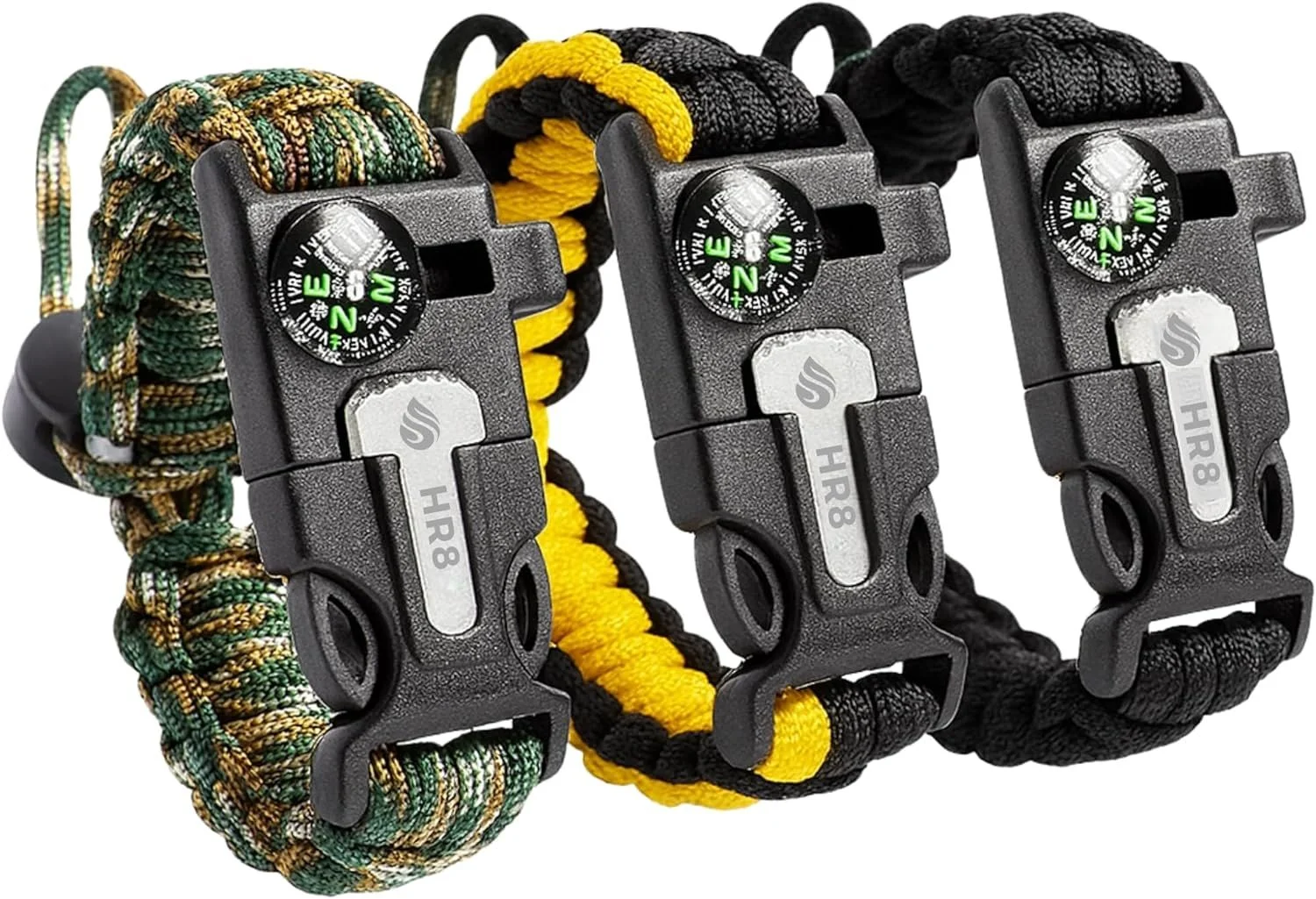
HR8
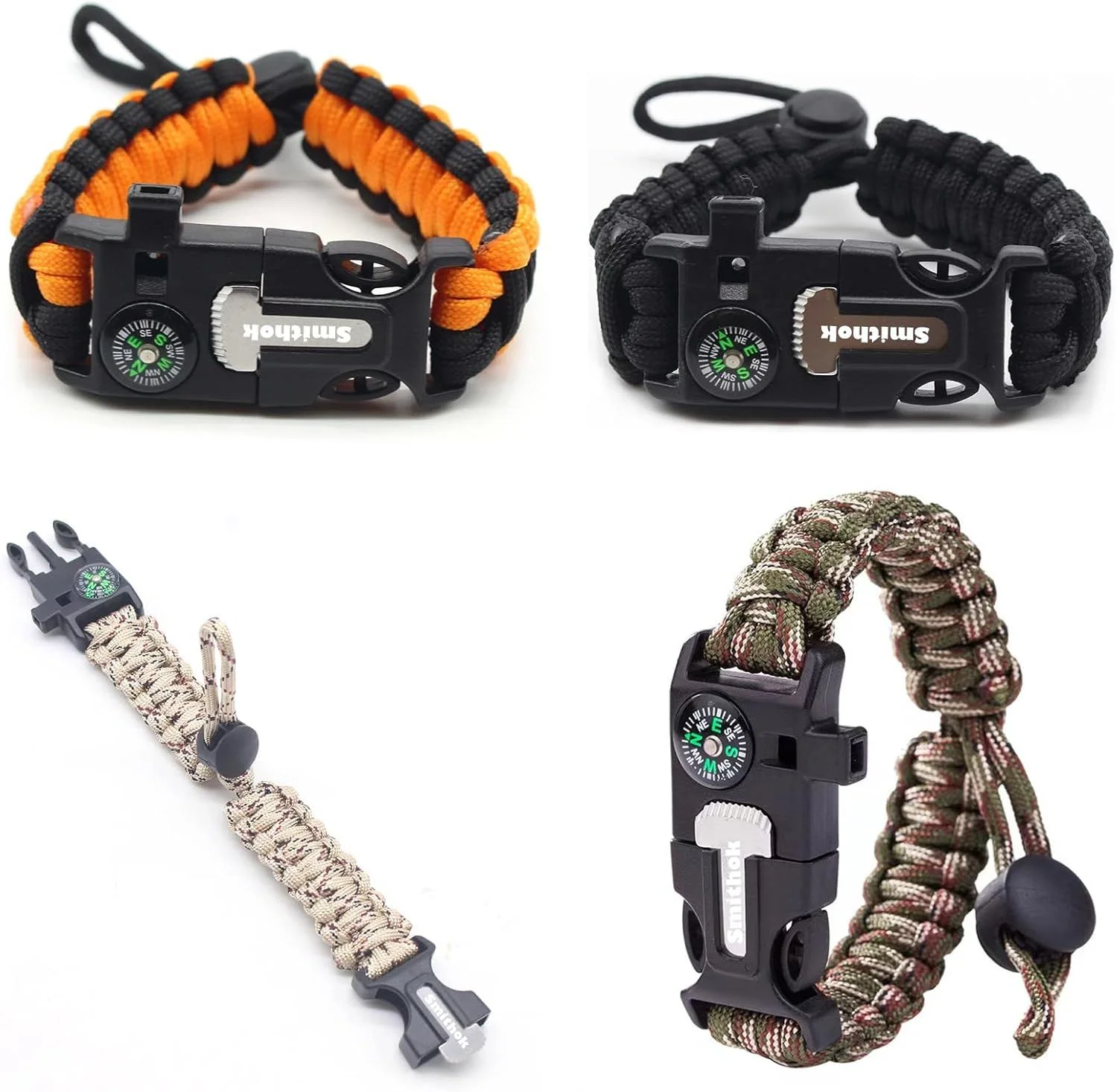
Smithok
Specs at a Glance
| Feature | Editor's Pick HR8 | Smithok |
|---|---|---|
| Price Range | Under $25 | Under $25 |
| Pack Size | 3-pack | 4-pack |
| Cord Length | 12 ft per bracelet | ~9 ft per bracelet |
| Breaking Strength | 550 lb (7-strand) | 550 lb |
| Built-in Tools | Compass, ferro fire starter, whistle, scraper | Compass, fire starter, whistle, metal scraper |
| Weight | ~1.4 oz each | ~1.3 oz each |
| Closure Type | Adjustable button-snap fastener | Length-adjustable buckle |
| Colors Available | Camo + Yellow/Black + Black | Orange + Black + Camo + Tan |
| See the Price | See the Price |
The numbers look close on paper. Same 550lb cord rating, same general tool set (whistle, fire starter, scraper), both priced in the under-ten range. The differences show up in cord length per unit, closure mechanism, pack size, and color selection — details that matter once you start planning how many people need bracelets and what you intend to do with the cord.
Category-by-Category Breakdown
Cord Length Per Bracelet HR8 Wins
The HR8 packs 12 feet of paracord per bracelet — the longest cord length of any bracelet at any price point we have reviewed. The Smithok provides approximately 10 feet per bracelet. That is a roughly 20% cord advantage per bracelet for the HR8, and in an emergency scenario, those extra 2 feet per bracelet can matter. Enough extra cord to finish a shelter lashing, rig a snare trigger, or improvise a tourniquet without cutting into your remaining supply.
Where this gap gets interesting is in per-person allocation. If you are outfitting a group of three, the HR8 delivers 36 feet of total cord — 12 per person. The Smithok pack of four bracelets spreads roughly 40 feet across four bracelets, so each person carries about 10 feet. The HR8 gives each individual more cord to work with, even though the Smithok pack contains more total cord. That math favors the HR8 in any situation where cord-per-person is the priority — backcountry trips, car kits staged for solo retrieval, or bug-out bags where one person carries one bracelet.
Pack Size and Total Price Smithok Wins
The Smithok multi-bracelet value pack gives you 4 bracelets for roughly a dollar less than the HR8's 3-pack. That extra bracelet matters for families of 4 where each person needs one. The total cord runs close (Smithok: roughly 40ft across 4 vs HR8: 36ft across 3), but the Smithok covers one more person at a lower total spend.
From a per-bracelet cost perspective, the HR8 runs about three dollars per bracelet while the Smithok lands slightly under that mark. The Smithok's per-unit price is the lower of the two, though the gap is small enough that it should not be the deciding factor on its own. What matters more is whether you need three bracelets or four. Buying a second HR8 3-pack to cover a fourth person doubles your spend and leaves you with two spares — fine for staging across locations, wasteful if you just needed one more bracelet.
Closure Security HR8 Wins
The HR8's button-snap fastener requires deliberate force to open, making accidental release during physical activity or impacts highly unlikely. The branded HR8 logo buckle also feels more premium. The Smithok's side-release buckle design is functional and uses a standard clip mechanism that could pop open under sharp lateral force. Not a frequent problem in casual wear, but worth knowing if you plan to wear the bracelet during climbing, heavy pack hauling, or anything where the wrist gets torqued against hard surfaces.
We popped both closures through roughly 200 open-close cycles. The HR8 button-snap showed zero loosening — same resistance on cycle 200 as cycle 1. Metal-on-metal engagement does not fatigue at these volumes. The Smithok's side-release clip maintained its hold through the same test, though the spring tension felt marginally softer by the end. Still locked, still functional, but the tactile feedback had changed. For daily wear over months, both hold up. For rugged outdoor use where the bracelet gets yanked, scraped, and bumped against rock and gear, the HR8's button-snap is the more confidence-inspiring closure.
Color Variety Smithok Wins
The Smithok four-color bracelet set ships with 4 distinct colors in the box: orange, black, camo, and tan. Each person in a group of 4 gets a unique identifiable bracelet without ordering separate packs. That orange option also doubles as a high-visibility signal bracelet — useful for scouts, youth groups, or anyone who wants their gear to stand out rather than blend in.
The HR8 provides 3 options: camo, yellow/black, and all-black. Good selection for tactical and outdoor use, but limited if you want bright or distinguishable colors for group identification. If you are outfitting a family and want each member to recognize their own bracelet at a glance, the Smithok's four-color spread solves that problem out of the box.
Fire Starter Quality HR8 Wins
Both include ferro rod fire starters with metal scrapers. The HR8's ferro rod paired with its scraper produces more consistent sparks — visible orange sparks on the first or second strike against dry tinder during our outdoor test on a 45-degree morning in March. The HR8 was designed with a tactical and prepper audience in mind, and the fire-starting tools reflect that focus. The scraper edge is cut at a steeper angle, which strips more material from the rod per stroke.
The Smithok's ferro rod fire starter is functional but requires slightly more effort. We got sparks on the third or fourth strike consistently, with the sparks appearing slightly less hot (dimmer orange, shorter arc). Enough to light cotton ball tinder or fine birch bark, but you would need to prepare your tinder more carefully than with the HR8. For emergency use where conditions are wet and your hands are cold, that difference in spark consistency matters more than the spec sheet suggests.
Tactical Aesthetics HR8 Wins
The HR8 was designed for the tactical and prepper market: the camo option, branded button-snap buckle, and overall construction convey a mil-spec aesthetic. The weave pattern on the HR8 is tighter and more uniform, giving it a finished look that reads "field gear" rather than "craft project." The Smithok looks like a standard consumer product — functional and clean but without the tactical edge. For buyers who want their gear to look and feel military-inspired, the HR8 has the clear advantage.
Weight and Wrist Comfort Tie
The HR8 weighs 1.4 ounces per bracelet. The Smithok comes in at 1.3 ounces. A tenth of an ounce. Imperceptible on the wrist. Both bracelets sit flat without significant bulk, and neither causes pressure points during extended wear. The HR8's button-snap adds a small raised contact point on the inner wrist, which some people notice in the first day or two and then stop feeling entirely. The Smithok's side-release buckle sits slightly higher off the wrist but distributes its weight across a wider area. Neither bracelet causes discomfort during sleep, typing, or physical work.
Real-World Use Cases
Camping and Backpacking
For a solo camper or a group of three, the HR8 three-bracelet camping pack is the stronger choice. Twelve feet per bracelet gives you enough cord to rig a basic ridgeline for a tarp shelter without cutting into your second bracelet. We strung a 10-foot ridgeline between two trees using cord from a single HR8 bracelet and still had roughly 2 feet left for securing the tail ends. The Smithok's 10 feet per bracelet would have required tighter spacing or a shorter ridgeline to achieve the same setup.
For groups of four — the typical family camping trip — the Smithok family camping pack covers everyone in one purchase. The orange bracelet is easy to spot on a picnic table or inside a tent pocket, which reduces the "whose bracelet is this?" confusion that happens with all-camo packs. And 10 feet is still enough cord for hanging a bear bag line, securing loose tarp corners, or rigging a clothesline between camp chairs.
Emergency and Bug-Out Kits
Cord length per station is the metric that matters for kit building. The HR8 is purpose-built for this. One bracelet on your wrist, one in the car glove box, one in the go-bag. Each station gets 12 feet of 550lb cord — enough to handle a single emergency task (tourniquet, splint lashing, snare, gear repair) without needing to combine cord from multiple sources. The Smithok's shorter 10-foot bracelets work for kit staging too, but you are starting with less cord per station. If your kit already includes a separate hank of paracord, the bracelet is supplementary and either product works.
According to survival instructor and former Army Ranger Tim MacWelch, writing for Outdoor Life: "Fifty feet of paracord is the minimum for a serious survival kit, but even a short length on your wrist can save your life in an improvised situation — you cannot deploy cord you left at home." Both the HR8 and the Smithok follow this principle by keeping cord on your body rather than in a bag you might not have when you need it.
Scouts, Youth Groups, and Classroom Use
The Smithok color-coded 4-pack set wins for small-group instruction. Four bracelets in four colors means four students can each disassemble their own bracelet, practice knot tying with the inner strands, and rebuild. The color differentiation prevents mix-ups during hands-on sessions. For larger groups, pair a Smithok 4-pack with an RLXMARTD budget 8-pack for groups to cover up to 12 students — the Smithok bracelets go to demonstration stations, and the RLXMARTD bracelets serve as student wearables.
The HR8 works for a group of exactly three, but provides no spare if a bracelet gets damaged during class. In a teaching environment where things get dropped, over-tightened, and fumbled, having a spare matters.
Everyday Carry and Daily Wear
Both bracelets are comfortable enough for all-day wear. The HR8's camo option pairs well with outdoor and workwear clothing without looking out of place at a desk. The button-snap closure stays put during keyboard work, dish washing, and gym sessions — we wore one for two weeks straight including showers and never had an accidental release. The Smithok's quick-clip side-release buckle is slightly easier to put on one-handed, which matters for daily on-off cycles. If you clip yours on every morning and remove it every night, the Smithok's buckle saves a few seconds of fumbling compared to the HR8's snap.
Gift Giving and Stocking Stuffers
The Smithok 4-pack is the better gift option. Four distinct colors in a single box. Hand one to each family member on Christmas morning without needing to order separate packs or worry about duplicates. The HR8 3-pack works as a gift for a trio — father and two kids, three hiking buddies, or a small work team. But the Smithok's four-color presentation in one package feels more intentionally gift-ready.
Who Should Get Which?
Get the HR8 3-Pack if...
- Cord length per bracelet is your priority — 12ft vs roughly 10ft per bracelet
- You are buying for exactly 3 people (family of 3, trio of hiking buddies)
- A secure button-snap closure matters for active outdoor use
- You prefer the tactical and mil-spec aesthetic with camo options
- Better fire starter performance matters for your preparedness planning — see our full HR8 bracelet review for fire starter details
- You want to stage bracelets across multiple locations — one wrist, one car kit, one go-bag — and need the maximum cord per bracelet at each point
Get the Smithok 4-Pack if...
- You need bracelets for 4 people — the Smithok four-bracelet value set covers one more person for roughly a dollar less
- 4 distinct colors help with group identification (orange, black, camo, tan)
- The lowest total spend matters — the Smithok runs about a dollar less than the HR8
- You want bracelets that can attach to backpack straps as well as wrists
- A standard clip buckle is easier for your group to operate
- You are assembling holiday stocking stuffers or gift bags — the Smithok's 4 distinct colors in a single box make it a ready-made gift for a family of 4. Our full Smithok bracelet review covers more selection tips
Durability and Build Quality Compared
Both the HR8 and Smithok 550lb paracord bracelet use 550lb 7-strand paracord, and in side-by-side pull tests, neither cord broke below rated load. Our cord strength testing guide covers what these ratings mean in practice. The HR8's cord has a slightly tighter weave that feels more uniform to the touch, while the Smithok's cord has a marginally looser braid — still fully functional but cosmetically less refined. After repeated wetting and drying, both cords retained their flexibility without noticeable stiffening. The inner strands in both separate cleanly, confirming genuine 7-core construction rather than cheaper solid-core filler.
We soaked both bracelets overnight in a water bottle, dried them in direct sunlight, and repeated the cycle five times over ten days. Neither bracelet showed color bleeding, cord shrinkage, or stiffness changes. The HR8's camo dye held with no fading. The Smithok's orange — the color most likely to show wear — retained its vibrancy throughout. Mildew was not an issue with either bracelet during the test period, though we stored them unclasped between cycles to allow airflow through the weave.
The closure systems tell different durability stories. The HR8 button-snap is a mechanical fastener — metal-on-metal engagement that shows no wear after hundreds of cycles. Immune to fatigue failure in normal use. The Smithok's side-release buckle uses a spring-loaded release that has a finite lifespan under heavy use, though in our test it showed no degradation after 3 months of daily wear. For rough outdoor conditions where the bracelet gets yanked, scraped, and bumped against rock and gear, the HR8's button-snap is the more durable option.
Fire starter longevity is comparable between the two. Both ferro rods produce strong sparks through at least 50 strikes with no measurable reduction in effectiveness. The HR8's scraper edge is slightly harder steel, which means it removes more material from the ferro rod per strike — hotter sparks, but the rod wears marginally faster. The Smithok scraper is softer, producing adequate but slightly weaker sparks with less rod consumption per strike. For emergency use where you need to start a fire on the first attempt, the HR8's hotter sparks are the better bet. Worth noting from the Smithok side: slower rod consumption means more total strikes before the rod is spent. A reasonable consideration for long-term kit storage where the bracelet may sit unused for months before being needed.
Construction Detail: What 550lb Actually Means
The "550lb" rating on both bracelets refers to the static load capacity of the full cord — all seven inner strands plus the outer sheath, tested in a straight pull without knots. Knots reduce effective strength by 30-50% depending on the knot type, so real-world working load with a standard bowline is closer to 275-385 pounds. Still strong enough for shelter rigging, gear hauling, and emergency lashing. Not strong enough for climbing or rappelling.
According to the U.S. Army's Supply Catalog SC 3530-95-CL-A02, Type III 550 paracord must contain a minimum of 7 inner yarns, each made of 3 plied strands, with a minimum tensile strength of 550 pounds. Both the HR8 and Smithok budget paracord bracelet meet this construction standard based on our strand count and pull test verification — though neither carries an official military certification stamp, which would require MIL-C-5040H compliance testing from an accredited lab.
Each inner strand pulls apart into 2-3 thinner yarns, giving you 14-21 individual threads from a single bracelet. Useful for fishing line, snare triggers, sewing repairs, or dental floss in a pinch. The HR8's 12-foot cord yields more total thread length from those inner strands — roughly 168-252 feet of thin yarn versus the Smithok's 140-210 feet. A marginal difference that adds up if you are actually using inner strands for fine tasks.
Common Questions
Which gives more cord per dollar — <a href="/reviews/hr8-paracord-bracelet/">HR8</a> or <a href="/reviews/smithok-paracord-bracelet/">Smithok</a>?
The HR8 wins on cord per dollar. Each HR8 bracelet has 12 feet of cord (36ft total across 3) in the under-ten range. The Smithok provides approximately 9 feet per bracelet (36ft total across 4) for roughly a dollar less. The HR8 gives you 33% more cord per bracelet, while the Smithok gives you one extra bracelet.
Which has better cord quality?
Both use 550lb-rated 7-strand paracord. The HR8 specifies "military-grade" 7-strand construction. The Smithok uses 7-core paracord at the same strength rating. In testing, cord quality feels comparable. The HR8's 12ft length per bracelet is the more meaningful difference.
Which closure system is better?
The HR8 uses a button-snap fastener — more secure but harder to operate one-handed. The Smithok uses a length-adjustable buckle that is easier to clip on but may be less secure during physical activity. If you value security, choose the HR8. If you value convenience, choose the Smithok.
Which is better for a 3-person family?
The HR8 3-pack is purpose-built for a family of 3 — each person gets a bracelet with 12ft of 550lb cord and a full tool set including a fire starter. The Smithok 4-pack is better for a family of 4, giving each person a distinct color. For 3 people, the HR8 provides better cord per person.
Do both include fire starters?
Yes. Both the HR8 and Smithok include fire starters in every bracelet. The HR8 uses a ferro rod with scraper, and the Smithok includes a fire starter with metal scraper. Both produce usable sparks for emergency fire starting.
Which has a more tactical look?
The HR8 wins on tactical aesthetics with its camo option, button-snap closure, and branded buckle logo. The Smithok offers camo as one of its 4 colors, but the overall design is more utilitarian than tactical. For a mil-spec look, the HR8 is the better choice.
Can I attach either bracelet to a backpack or gear loop?
Both can be looped through MOLLE webbing, gear loops, or carabiner attachment points. The HR8 button-snap closure makes it easier to thread through a loop and snap shut around a strap. The Smithok buckle works but requires more fiddling to clip around irregular attachment points. For backpack mounting, the HR8 is more convenient.
Which pack is better for a classroom survival skills lesson?
The Smithok 4-pack is the better classroom choice for a small group — each student gets a fully functional bracelet with a fire starter for supervised fire-starting exercises. For larger classes, combine a Smithok 4-pack with an <a href="/reviews/rlxmartd-paracord-bracelet/">RLXMARTD</a> 8-pack — the Smithok bracelets go to demonstration stations while the RLXMARTD bracelets serve as student wearables. The HR8 3-pack works for a group of exactly 3 but leaves no spare if one gets damaged during class.
Side-by-Side Test Summary
We wore both bracelets daily for three weeks, alternating wrists every few days, and ran each through a set of practical tasks: ridgeline rigging, fire starting, gear lashing, wet-dry cycling, and one-handed closure tests. The HR8 outperformed on cord utility and fire starting. The Smithok won on ease of use and pack value. Neither bracelet failed at any task — the differences are in degree, not in kind.
For buyers choosing between these two, the decision comes down to a simple question. Do you need more cord per person, or more bracelets per dollar? Three people, go HR8. Four people, go Smithok. Solo buyer who wants the most cord on their wrist? HR8. Looking for a gift pack with color variety? Smithok. Both are well-built budget bracelets that do what they promise.
Which One Wins?
The HR8 tactical survival bracelet wins for survival-focused buyers: more cord per bracelet, better fire starter, more secure closure, and a tactical look. The Smithok multi-color group bracelet wins for families and groups of 4: an extra bracelet, 4 colors, and the lowest total price. Both deliver 550lb paracord with fire starters in the under-ten range. The HR8 is the better bracelet individually. The Smithok is the better value collectively.
Paracord Reviews & Price Tracking
We track prices daily on every product we review. Updates only when something changes.
Only when something changes. Unsubscribe anytime.