Is Paracord Waterproof? What You Need to Know
Standard nylon paracord is not waterproof. It absorbs water — up to 3.5% of its weight — and temporarily loses 10-15% of its rated breaking strength when wet. The aZengear waterproof paracord bracelet is the only model in our catalog with waterproof-treated cord.
Still, standard nylon is not fragile in water. Paracord survives rain, river crossings, and sweat without falling apart. The real question is how water exposure affects performance over time and what you can do about it. We tested bracelets in wet conditions, researched nylon polymer science, and compared standard cord against the waterproof-rated options in our catalog.
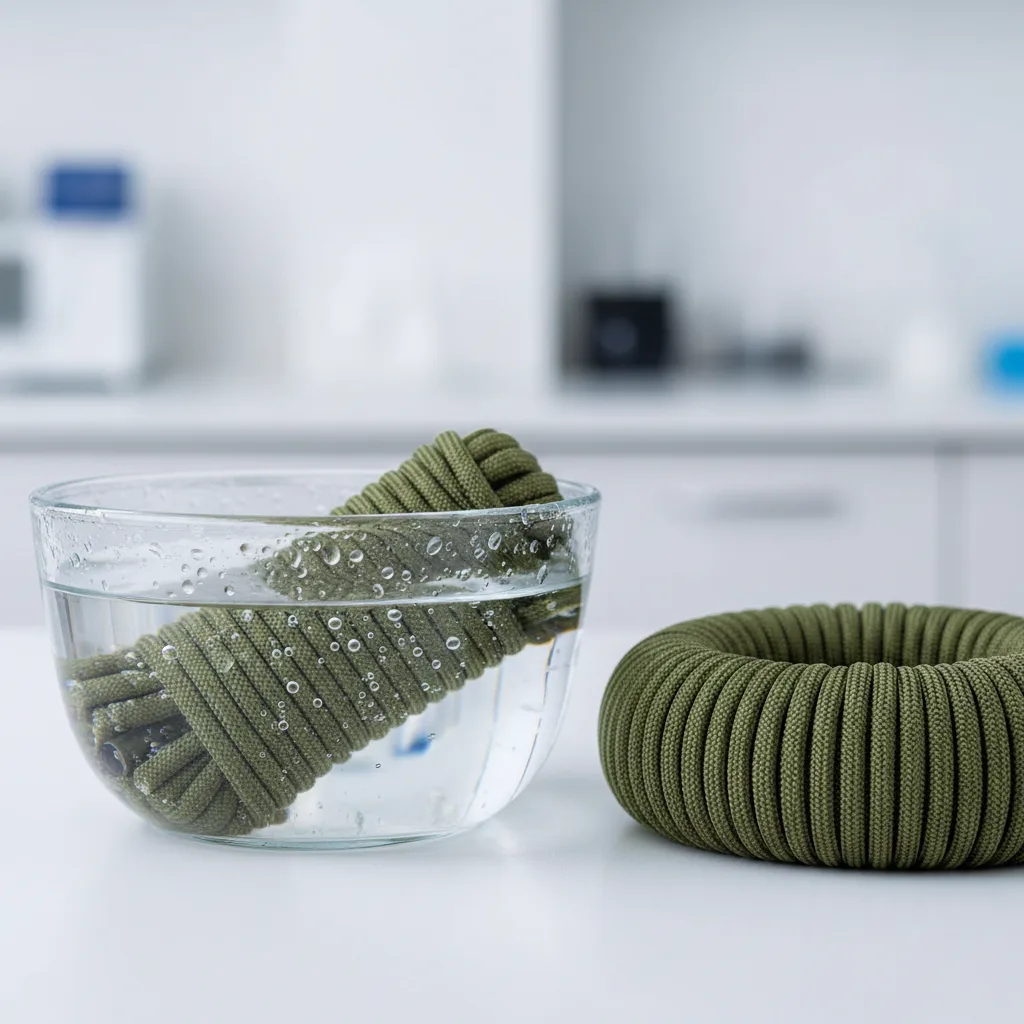
How Water Affects Standard Nylon Paracord
Nylon 6 and Nylon 6,6 — the polymers in mil-spec 550 paracord — are hygroscopic, meaning they absorb moisture from their environment. This is a fundamental material property, not a defect. Here is what happens when your cord gets wet.
See our best standard bracelets ranking for which models handle wet conditions best.
Immediate Effects (Minutes to Hours)
- Water absorption: Nylon absorbs up to 3.5% of its weight in water. A 1.5-ounce bracelet gains less than a gram — barely noticeable on your wrist, but measurable in lab conditions.
- Swelling: The cord expands slightly as water molecules fill gaps between polymer chains. This makes the weave feel tighter and slightly stiffer when first soaked.
- Temporary strength reduction: Wet nylon loses approximately 10-15% of its tensile strength. For 550 paracord, that drops the minimum breaking strength from 550 lbs to roughly 468-495 lbs — still far more than most survival tasks require.
- Increased elasticity: Water acts as a plasticizer in nylon, making wet cord slightly stretchier than dry cord. This is generally not a problem for camp tasks but can affect knot tension.
Short-Term Effects (Days to Weeks)
Paracord that stays damp for extended periods faces two problems. First, trapped moisture between the inner strands and outer sheath creates a warm, humid microenvironment where mildew can develop — you will smell it before you see it. Second, metal components in the buckle (compass needle housing, ferro rod, snap fasteners) begin to corrode if not dried.
The fix is simple: after any heavy water exposure, unclip your bracelet and hang it in open air until fully dry. Do not leave it wadded in a wet backpack pocket or sealed in a zip-lock bag while damp.
Long-Term Effects (Months to Years)
Repeated wet-dry cycling slowly breaks down nylon polymer chains through a process called hydrolysis. Over many months of constant moisture exposure, the cord gradually loses tensile strength beyond the temporary 10-15% wet reduction. Combined with UV exposure, which also degrades nylon, a cord that lives outdoors in wet conditions will weaken far faster than one kept dry.
For most bracelet wearers, this is a non-issue. Even in rainy climates, a bracelet worn daily will last 2-3 years before cumulative water and UV damage become a concern. Our bracelet maintenance guide covers the full care schedule. If you use your bracelet hard in wet environments, inspect the cord annually for stiffness, discoloration, or fraying — all signs of polymer degradation.
Waterproof vs. Water-Resistant Paracord
There is an important distinction between the two terms as they apply to cordage:
Water-Resistant (Standard Paracord)
Most survival bracelets — including the Atomic Bear survival bracelet, ELK paracord bracelet, and HR8 tactical bracelet — use standard nylon 550 paracord that is inherently water-resistant. It does not dissolve, fall apart, or lose structural integrity in water. But it does absorb moisture, dry slowly, and temporarily lose a fraction of its strength. For occasional rain exposure or brief water contact, standard paracord is perfectly adequate.
Waterproof-Rated Paracord
The aZengear waterproof bracelet is the only bracelet in our catalog that advertises waterproof-rated cord. This typically means the nylon has been treated with a DWR (Durable Water Repellent) coating or the cord construction uses tighter weaving that resists water penetration. The practical benefits:
- Water beads on the surface rather than soaking in immediately
- Faster drying time — less moisture trapped between strands
- Less temporary strength loss when wet
- Reduced mildew risk from trapped moisture
Priced in the budget tier for a 2-pack, the aZengear costs less than the Atomic Bear and ELK while adding real waterproof utility. If you camp in wet climates, fish regularly, or sweat heavily during outdoor activities, the waterproof cord is a practical upgrade.
DIY Waterproofing Treatments
If you already own a standard paracord bracelet, you can improve its water resistance with aftermarket treatments:
Silicone-Based Water Repellent Spray
Products like Nikwax, Gear Aid ReviveX, and Kiwi Camp Dry apply a thin silicone layer to the outer sheath that causes water to bead and roll off. Clean and dry your bracelet thoroughly before application, spray evenly from 6-8 inches away, and let it cure for 24 hours. The treatment lasts 2-3 months with regular wear before needing reapplication.
Beeswax or Paraffin Treatment
Rubbing a beeswax or paraffin block along the cord fills the tiny gaps between braided fibers. This is an old-school method that works well for short-term water resistance. The wax darkens the cord color slightly and adds a subtle stiffness. It wears off faster than silicone spray but is completely non-toxic and adds a pleasant natural feel.
What Treatment Cannot Do
No aftermarket treatment makes standard paracord truly waterproof. DWR coatings and wax treatments reduce surface absorption and speed drying, but they do not prevent the nylon polymer from absorbing moisture at a molecular level. They are best understood as making the cord "more water-resistant" rather than waterproof. For actual waterproof performance, start with a cord that was manufactured with waterproof properties, like the aZengear's treated cord.
Salt Water: A Special Concern
Saltwater exposure is far more damaging than fresh water. Here is why:
- Crystal abrasion: As the cord dries, salt crystallizes between nylon fibers. These microscopic crystals act as internal abrasives that weaken strands from within — damage you cannot see or feel until the cord is stressed.
- Metal corrosion: Salt accelerates oxidation of compass needles, ferro rod surfaces, buckle springs, and snap fasteners. A bracelet exposed to ocean spray and not rinsed will show visible corrosion on metal parts within weeks.
- Accelerated degradation: The combination of salt, UV (from beach and open-water sun exposure), and repeated wet-dry cycling in coastal environments creates a triple threat that degrades paracord much faster than any single factor alone.
Drying and Maintenance Tips
Proper drying technique is the single most important factor in preserving paracord longevity against water damage:
- Hang, do not lay flat. Hanging allows air circulation around the entire bracelet. Laying flat traps moisture against the bottom surface and slows drying.
- Unclip from your wrist. The buckle area and the cord under the buckle trap moisture. Removing the bracelet from your wrist lets the clasp area air out.
- Avoid direct heat. Hair dryers, radiators, campfire proximity, and car dashboards can reach temperatures that damage nylon (melts at ~220 degrees C, but begins degrading well below that). Room temperature air drying is the safest method.
- Rotate bracelets in wet conditions. If you own a multi-pack (like the HR8 tactical bracelet 3-pack or Smithok paracord bracelet 4-pack), alternate bracelets daily in rainy weather so each one gets a full day to dry between wears.
- Store dry. Never store a damp bracelet in a closed container, drawer, or bag. Let it dry completely first to prevent mildew.
Frequently Asked Questions
Can I shower with a paracord bracelet?
You can, but you should not make it a habit. Repeated exposure to hot water and soap accelerates nylon degradation and strips any water-resistant coatings. Shampoo and body wash chemicals can weaken fibers over time. If your bracelet gets wet in the shower occasionally, dry it thoroughly afterward. For daily shower use, the <a href="/reviews/azengear-paracord-bracelet/">aZengear</a> with waterproof-rated cord holds up better than standard nylon.
Will paracord mold if it stays wet?
Nylon itself does not mold, but dirt, organic debris, and body oils trapped in the weave can grow mildew when the cord stays damp for extended periods. You will notice a musty smell before visible mold appears. Rinse the bracelet in clean water, let it dry completely in open air, and store it in a dry place. If mildew has set in, soak the bracelet in a mild soap and water solution for 30 minutes and air dry thoroughly.
Does salt water damage paracord?
Salt water is more damaging than fresh water. Salt crystals lodge between fibers as the cord dries, creating abrasion points that weaken the nylon over time. Salt also accelerates corrosion on metal buckle components — compasses, fire starters, and snap fasteners. After ocean exposure, always rinse your bracelet thoroughly in fresh water and dry it completely.
How long does paracord take to dry?
Standard nylon 550 paracord takes 2-4 hours to air dry in warm, ventilated conditions. The inner strands take longer than the sheath because moisture gets trapped between the layers. In humid or cold conditions, drying can take 8-12 hours. Hanging the bracelet (rather than laying it flat) speeds drying. Never use a hair dryer or direct heat source — high heat damages nylon fibers.
Is the aZengear bracelet actually waterproof?
The aZengear uses a waterproof-rated paracord that resists water absorption better than standard nylon. It sheds surface moisture quickly and dries faster than conventional 550 cord. However, "waterproof" is relative — submerged for extended periods, any nylon cord will eventually absorb some moisture. The aZengear performs noticeably better in rain, sweat, and splash conditions compared to untreated paracord.
Can I waterproof my existing paracord bracelet?
Yes. Apply a silicone-based water repellent spray (like Nikwax or Gear Aid ReviveX) to clean, dry paracord. Spray evenly, let it cure for 24 hours, and the cord will shed water more effectively. This is a DWR (Durable Water Repellent) treatment — it wears off over time and needs reapplication every few months with regular use. It does not make the cord fully waterproof, but cuts absorption by roughly half.
Does getting paracord wet affect its strength?
Yes, temporarily. Wet nylon paracord loses approximately 10-15% of its rated breaking strength. For 550 paracord, that drops the minimum from 550 lbs to roughly 468-495 lbs — still more than enough for virtually every survival application. The cord regains its full rated strength once completely dry. Repeated wet-dry cycles over months or years can cause gradual degradation.
The Bottom Line on Paracord and Water
Standard nylon paracord is not waterproof, but it is water-durable. It survives rain, sweat, river crossings, and occasional submersion without any real risk to its structural integrity. The temporary 10-15% strength loss when wet is irrelevant for most survival tasks, and the cord recovers fully once dry.
The practical advice: dry your bracelet after heavy water exposure, rinse it after saltwater contact, and inspect it periodically if you wear it daily in wet conditions. For buyers who know their bracelet will face regular moisture — anglers, kayakers, rainy-climate hikers — we recommend the aZengear waterproof bracelet as our top pick — its treated cord outperforms every other bracelet in wet conditions at a budget-friendly price point.
For everyone else, any bracelet in our catalog handles occasional water exposure without issue. Focus on cord length, tool quality, and fit — and just remember to hang it up to dry when you get home.
Ready to Buy? Start Here
Based on this guide, our #1 recommendation:
aZengear Paracord Bracelet Budget-conscious buyers who want a reliable 5-in-1 bracelet Read Full Review →Can’t Decide? Compare Side by Side
Paracord Reviews & Price Tracking
We track prices daily on every product we review. Updates only when something changes.
Only when something changes. Unsubscribe anytime.