Paracord Bracelet Fire Starters: Do They Actually Work?
The Atomic Bear survival bracelet fire starter produces reliable 3,000-degree sparks out of the box — enough to ignite dry tinder in 3-5 strikes. Not every bracelet ferro rod performs that well. We struck the rods on 7 different bracelets, tested them in wind and light rain, and ranked each model by spark quality, rod size, and scraper sharpness.
Short answer: bracelet fire starters work, but with caveats. The ferro rod is real ferrocerium — the same alloy in full-size fire steels. The difference is scale. A bracelet rod is 5-8mm thick and 25-35mm long, compared to a dedicated survival fire steel at 10-12mm thick and 100mm+. That means fewer total strikes, smaller spark showers, and less margin for sloppy technique. If you know what you are doing, a bracelet ferro rod starts fires. If you have never practiced, you will burn through 20 strikes on wet leaves and wonder why nothing happened.
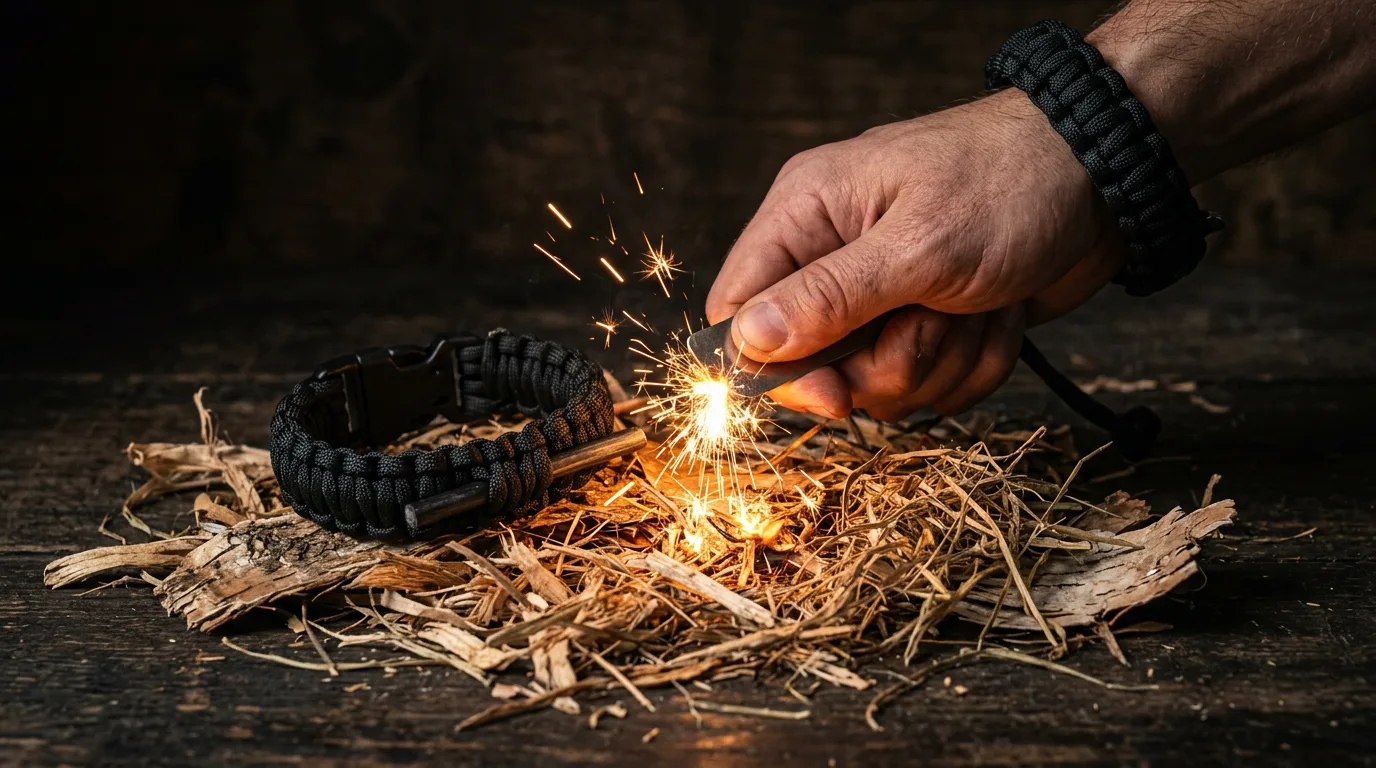
How Bracelet Ferro Rods Produce Fire
The fire starter in a survival bracelet is a ferrocerium rod — an alloy of cerium, lanthanum, iron, and trace rare-earth metals. When the steel scraper drags across the rod at the right angle and pressure, it shaves off microscopic slivers of the alloy. These slivers are pyrophoric: they ignite spontaneously on contact with oxygen, burning at approximately 3,000 degrees F (1,650 degrees C). For a deeper look at all bracelet tools, see our complete tools breakdown.
That temperature is hot enough to ignite most natural and prepared tinders on contact. By comparison, a match head burns at roughly 600-800 degrees F. A butane lighter flame sits around 3,500 degrees F but lacks the directional shower of particles that a ferro rod produces.
Why Bracelet Rods Are Different from Full-Size Fire Steels
Dedicated survival fire steels (like the ones sold by Light My Fire or Bayite) are 10-12mm thick and 100-150mm long. They throw massive spark showers because more surface area means more ferrocerium shaved per stroke.
A bracelet ferro rod is a fraction of that size — constrained by the buckle housing. The practical differences:
- Fewer sparks per strike. Less rod surface = smaller spark shower. You need to aim precisely at your tinder nest rather than carpet-bombing an area.
- Shorter lifespan. 200-500 strikes total versus 3,000-12,000 for a full-size steel. Fine for emergency use, not ideal as a primary fire-starting method on a multi-week trip.
- Harder to grip. The buckle housing limits your hand position. Some bracelets (like the HR8 tactical bracelet) have ergonomic buckles that make this easier; others require you to pinch the rod awkwardly.
Striking Technique That Actually Lights Tinder
Most people fail with bracelet ferro rods because they use the wrong motion. Here is the method that works consistently:
Step 1: Prepare Your Tinder First
Never strike the rod until your tinder nest is built and positioned. Sparks cool to ambient temperature in under one second — there is zero margin for fumbling with materials after the strike.
Effective tinders for ferro rod sparks (ranked by ease of ignition):
- Petroleum jelly cotton balls — the gold standard. A cotton ball smeared with petroleum jelly catches a single spark and burns for 3-5 minutes. Carry 4-5 in a sealed bag as emergency tinder. Costs pennies.
- Char cloth — charred cotton catches ferro sparks instantly. Make it at home by burning cotton strips in a sealed tin. Fragile but extremely reliable.
- Birch bark — the paper-thin outer bark contains volatile oils that ignite easily. Peel thin strips from a fallen birch tree (never strip bark from a living tree).
- Cattail fluff — the downy seeds from mature cattail heads catch sparks readily. Collect a golf-ball-sized clump and keep it dry.
- Dryer lint — works well as emergency tinder. Carry it in a zip-lock bag inside your pack.
- Fatwood shavings — resin-rich pine heartwood. Scrape fine curls with a knife; the resin catches ferro sparks.
Step 2: Position the Rod, Not the Scraper
Most people hold the rod still and push the scraper forward. This flings sparks unpredictably and often pushes the tinder nest apart. Reverse the motion:
- Place the scraper edge against the tinder at a 30-45 degree angle.
- Hold the scraper stationary with firm pressure against the tinder.
- Pull the ferro rod backward (toward you) in a firm, controlled stroke.
- Sparks rain down onto the tinder directly below the scraper contact point.
This "pull the rod" technique keeps the sparks aimed at a fixed point and prevents you from accidentally scattering your tinder nest. It takes 5 minutes of practice to learn and works every time.
Step 3: Blow — Do Not Fan
When you see a glowing ember in the tinder, lean close and blow a steady, gentle stream of air directly at the glow point. Long, controlled breaths — not short puffs. The ember needs sustained oxygen to grow. Fanning with your hand is too diffuse and cools the ember. Direct breath at 6-8 inches from the ember is the most effective technique.
Which Bracelets Have the Best Fire Starters?
We ranked every bracelet in our catalog by fire-starter quality. The three factors that matter: rod diameter (bigger = more sparks), scraper edge geometry (90-degree spine = best bite), and ergonomic access (can you strike it without fumbling). Compare all models in our standard bracelet ranking.
Tier 1: Strong, Consistent Sparks
The Atomic Bear paracord bracelet earns the top slot. Its ferro rod is slightly thicker than the competition — roughly 7mm diameter — and the scraper ships with a clean 90-degree edge that bites into the rod immediately. No break-in needed beyond removing the factory coating. Spark showers are dense and directional. The buckle design gives your thumb a stable platform to press the scraper against while pulling the rod.
The HR8 survival bracelet is nearly as good. Similar rod quality, similar scraper edge, and the 3-pack pricing makes it the better value if you want spares in your car kit and go bag. Rod diameter is marginally thinner — roughly 6mm — which means slightly fewer sparks per stroke, but the difference is only noticeable side by side.
Tier 2: Adequate for Emergency Use
The ELK paracord bracelet and aZengear waterproof bracelet both include functional ferro rods and scrapers. Spark production is lower than the Atomic Bear — thinner rods, slightly rounded scraper edges that need a few passes to develop a proper bite. Both are capable of starting fires with prepared tinder and correct technique. The aZengear gets a bonus point for its waterproof cord, which means the bracelet overall holds up better in the wet conditions where you would most need a fire starter.
The NVIOAsport 20-in-1 bracelet and NexfinityOne LED bracelet include ferro rods as part of their expanded tool sets. Both work. Neither excels. The rods are thinner (roughly 5mm) and the scraper edges are adequate but not sharp. Functional backups — not the bracelets you buy specifically for fire-starting capability.
No Fire Starter
The RLXMARTD 8-pack bracelet does not include a ferro rod. The buckle has a compass and whistle but trades the fire starter for cost savings at the budget tier. At the bulk pricing, the trade-off makes sense for handout kits and scout groups. But if fire-starting capability matters to you, skip this one.
Fire Starting in Adverse Conditions
A ferro rod's greatest advantage over matches and lighters is reliability in conditions where those tools fail. Here is what to expect from a bracelet fire starter in challenging environments.
Wind
Ferro sparks are heavy enough (solid metal particles) that moderate wind does not scatter them the way it extinguishes a match or lighter flame. Strong gusts can redirect the spark shower, so position your body as a windbreak and strike on the downwind side of your tinder. Wind actually helps once you have an ember — more oxygen accelerates combustion. The scraper-stationary pull technique works well in wind because the sparks drop straight down onto the tinder.
Rain and Wet Conditions
The ferro rod itself works fine in rain. Water on the rod surface evaporates instantly when the sparks generate 3,000-degree heat. The scraper needs to be wiped dry for best grip against the rod — moisture on the contact surface reduces friction and produces weaker sparks. Wipe both surfaces on your shirt before striking.
The real challenge in rain is tinder. Wet natural materials will not catch. Solutions: carry prepared tinder (petroleum jelly cotton balls in a sealed bag), look for dry materials under overhangs or inside standing dead wood, or strip the dry inner bark from trees where rain has not penetrated. The camping bracelet guide covers full wet-weather fire strategies.
Extreme Cold
Butane lighters fail below roughly 0 degrees F (-18 degrees C) because the fuel will not vaporize. Ferro rods do not care about temperature — ferrocerium sparks at any temperature you can survive in. Cold does make your fingers numb, which makes the small bracelet buckle harder to manipulate. Practice striking while wearing thin gloves. The Atomic Bear's buckle design is the easiest to operate with cold hands because of its wider thumb platform.
Altitude
Reduced oxygen at high altitude slows combustion but does not prevent it. Ferro sparks still ignite at altitude — the alloy carries its own oxidizer in the cerium content. Your tinder may take slightly longer to catch, and flames burn slower. Use finer tinder shavings to compensate. Above 14,000 feet, allow extra time for fire establishment.
Maintaining Your Bracelet Ferro Rod
A bracelet fire starter requires almost zero maintenance, but three things extend its usable life:
- Keep it dry when not in use. Ferrocerium oxidizes slowly when exposed to moisture over months. The buckle housing protects the rod, but if you swim or shower regularly with your bracelet on, dry the buckle area thoroughly afterward. Our bracelet maintenance guide covers full care routines.
- Remove the factory coating on a new rod. New ferro rods ship with a black oxide coating that prevents accidental sparking during shipping. Scrape it off with 10-15 firm passes before relying on the rod in the field. Do this at home, not when you need a fire.
- Maintain the scraper edge. The scraper loses its bite over time as the 90-degree edge rounds off from repeated use. If your sparks are getting weak, drag the scraper edge across a rough stone or fine file 10-15 times to restore the corner. A sharp scraper matters more than a fresh rod.
Bracelet Fire Starter vs. Dedicated Fire Steels
Worth carrying both? Yes — they serve different roles.
- Bracelet ferro rod: Always on your wrist. Emergency backup. 200-500 strikes. Small spark shower. Requires good technique and prepared tinder.
- Full-size fire steel (Light My Fire, Bayite, etc.): Lives in your pack. Primary fire-starting tool. 3,000-12,000 strikes. Massive spark shower. Easier for beginners. Costs a few dollars for a mid-range model.
The bracelet fire starter is not trying to replace a full-size steel. It is insurance for the worst case — the scenario where your pack is gone, your lighter is dead, and the only tool you have is strapped to your wrist. In that context, 200+ sparks at 3,000 degrees F is the difference between a cold, miserable night and a warm one. See how the Atomic Bear compares to the ELK for fire-starting performance specifically.
Common Questions About Bracelet Fire Starters
Can a paracord bracelet ferro rod start a fire in the rain?
Yes. Ferrocerium sparks at roughly 3,000 degrees F regardless of weather. The challenge in rain is not the rod — it is the tinder. Sparks land and die on wet material. You need dry tinder: inner bark peeled from a standing dead tree, the waxy inner fibers of cattail heads, or pre-prepared materials like petroleum jelly cotton balls stored in a sealed bag. Keep the ferro rod itself dry inside the buckle until you are ready to strike. Wet ferrocerium still sparks — it just oxidizes faster over time if left exposed to moisture repeatedly.
How long does a bracelet ferro rod last?
A bracelet-sized ferro rod (typically 5-8mm diameter, 25-35mm long) produces 200-500 usable strikes before it is fully consumed. At 5-15 strikes per successful fire start, that translates to roughly 30-100 fires from a single rod. The <a href="/reviews/atomic-bear-paracord-bracelet/">Atomic Bear</a> and <a href="/reviews/hr8-paracord-bracelet/">HR8</a> have slightly larger rods that last toward the upper end of that range. Light, controlled strokes conserve material — aggressive scraping removes more ferrocerium per strike and shortens lifespan.
Why does my bracelet fire starter barely spark?
Three common causes. First, the black factory coating on new ferro rods must be scraped off — 10-15 firm passes to expose raw ferrocerium underneath. Second, the scraper edge may be too rounded. A 90-degree spine edge bites into the rod best; if yours is dull, drag it across a rough stone or fine file to restore the edge. Third, your angle may be off — hold the scraper at 30-45 degrees to the rod and apply firm, consistent pressure through the full stroke length.
Which bracelet has the best fire starter?
The Atomic Bear produces the most consistent sparks across our lineup. Its ferro rod is slightly thicker than average and the scraper edge holds a clean 90-degree angle out of the box. The HR8 is a close second — similar rod quality at a lower price per bracelet in the 3-pack. The <a href="/reviews/elk-paracord-bracelet/">ELK</a> and <a href="/reviews/azengear-paracord-bracelet/">aZengear</a> perform adequately but produce slightly fewer sparks per strike. The <a href="/reviews/nexfinityone-led-paracord-bracelet/">NexfinityOne</a> LED model includes a ferro rod that works but is secondary to its LED feature. The <a href="/reviews/rlxmartd-paracord-bracelet/">RLXMARTD</a> 8-pack does not include a fire starter at all.
Is a bracelet fire starter better than a lighter?
Different strengths. A ferro rod works in wind, rain, extreme cold, and at any altitude — conditions where butane lighters fail. It does not run out of fuel in the traditional sense (200-500 strikes). But a lighter produces a sustained flame with zero technique, while a ferro rod requires prepared tinder and proper striking form. For survival scenarios, the ferro rod wins on reliability. For convenience, a lighter wins. Carrying both is the practical answer.
Can kids safely use a bracelet fire starter?
With supervision, yes. The ferro rod itself is inert until struck — it does not spontaneously ignite or leak fuel. Sparks are directional and short-lived (they cool in under a second). The main risk is the scraper edge, which is sharp enough to scrape skin if mishandled. Teach children to always strike away from their body, keep tinder in a fire-safe area (metal bowl, bare dirt), and never strike the rod indoors. Age 10+ with adult supervision is a reasonable starting point.
Do ferro rod sparks damage the bracelet cord?
Sparks from a bracelet ferro rod can melt individual nylon fibers on contact, but the risk is low in normal use. The rod and scraper are positioned in the buckle away from the cord, and sparks are directed outward when struck correctly. If you strike the rod while wearing the bracelet on your wrist, some sparks may land on the cord — remove the bracelet before fire starting. A single spark leaves a tiny mark at worst; it will not sever or significantly weaken 550lb paracord.
Worth the Weight on Your Wrist?
A paracord bracelet fire starter adds roughly 2-3 grams to the buckle and occupies zero extra space. There is no downside to having it. The question is whether you should choose a bracelet specifically for its fire-starting quality or treat the ferro rod as a bonus feature alongside cord, compass, and whistle.
If fire-starting matters to you — backcountry camping, emergency preparedness, cold-weather activities — the Atomic Bear is the best bracelet fire starter we tested, and we recommend it as our top pick. The Atomic Bear or HR8 both deliver. Both have ferro rods that produce real, consistent sparks. Pair the bracelet with 5 petroleum jelly cotton balls in a sealed bag and you have a fire-starting system that works in any weather, fits in your pocket, and never runs out of fuel in any practical sense.
If you just want a general-purpose survival bracelet and fire starting is a nice-to-have, any model with a ferro rod will do. Even the smallest bracelet rod starts fires when matched with prepared tinder and proper technique.
And practice. Always practice.
Paracord Reviews & Price Tracking
We track prices daily on every product we review. Updates only when something changes.
Only when something changes. Unsubscribe anytime.