Paracord Bracelet Tools Explained
A modern survival bracelet packs 4 to 20 tools into a buckle smaller than a matchbox — compass, fire starter, whistle, scraper, and in premium models, LED lights and thermometers. But how well do these miniaturized tools actually work? Our best standard bracelets ranking rates tool quality across every model.
We tested every tool across 9 survival bracelets to separate practical features from marketing gimmicks — the Atomic Bear is the best overall for core tool quality, and the NVioAsport wins on sheer tool count. This guide explains what each tool does, how to use it properly, and which bracelets deliver the best version of each one.
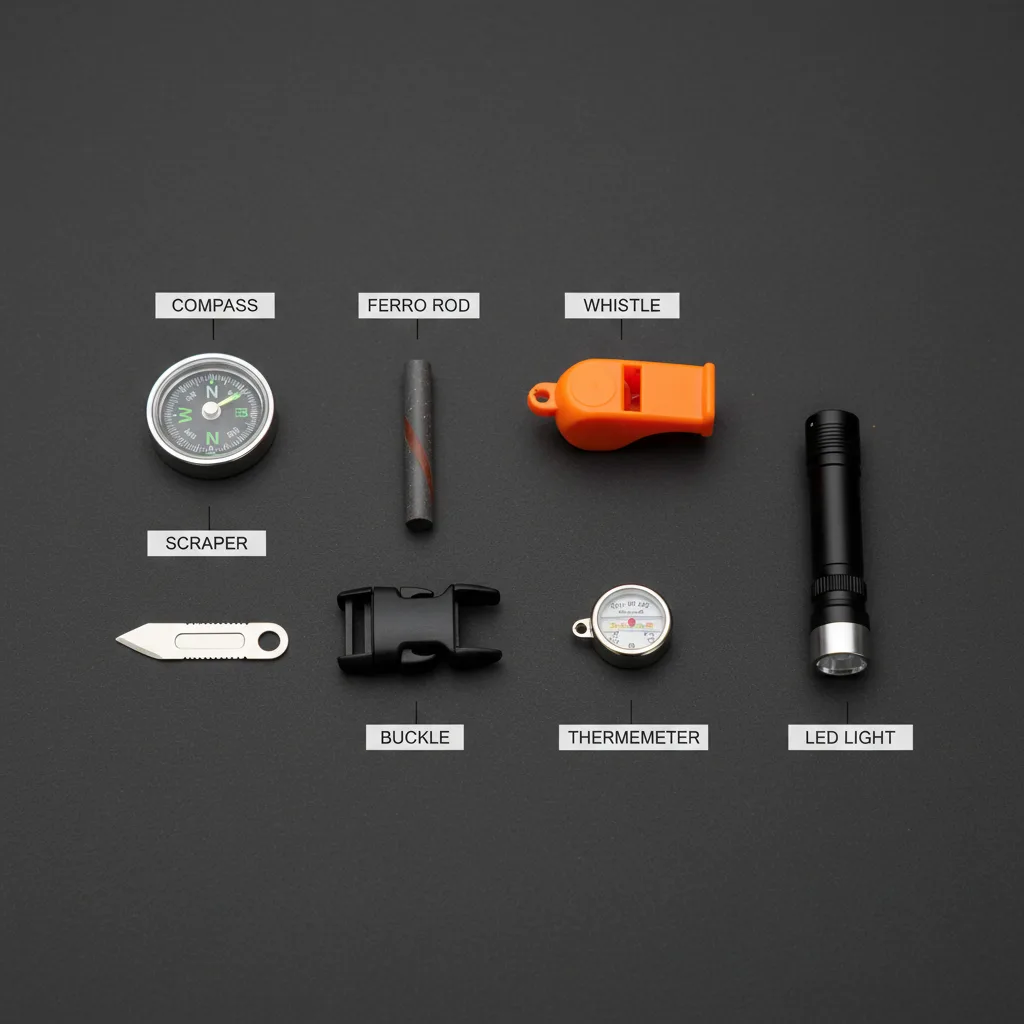
The Core Five: Tools in Every Standard Bracelet
Nearly every survival bracelet includes five tools in the buckle: a button compass, a ferrocerium fire starter, an emergency whistle, a steel scraper, and 8-12 feet of 550lb paracord. Here is what each one does and how to get the most from it.
1. Compass
The compass is a liquid-filled button compass embedded in the top of the buckle, typically 15-20mm in diameter. It uses a magnetized needle floating in a damping fluid to indicate magnetic north. Our bracelet buying guide covers how compass quality varies across price points.
How It Works
The magnetized needle aligns with Earth's magnetic field, pointing toward magnetic north. The rotating dial (or fixed markings) around the needle indicate cardinal and intercardinal directions. Hold the bracelet flat and level, away from metal objects, and wait 3-5 seconds for the needle to settle.
Accuracy and Limitations
Bracelet compasses are accurate to approximately 10-15 degrees — enough to identify cardinal directions and maintain a general heading, but not precise enough for plotting a course on a topographic map. Common issues include:
- Metal interference: Other bracelet components (scraper, ferro rod) can deflect the needle. Remove the bracelet and hold it at arm's length for the most accurate reading.
- Temperature sensitivity: Cold temperatures thicken the damping fluid, causing the needle to respond sluggishly. The aZengear survival bracelet compass is notably slower in temperatures below 40 degrees F.
- Bubble formation: Temperature cycling can create an air bubble in the compass housing that interferes with needle rotation. This is a common issue across all bracelet compasses.
Best Compass
The NVioAsport 20-in-1 model and NexfinityOne LED model feature slightly larger compass dials (0.79 inches) than standard bracelets, making them easier to read. See our best LED bracelets roundup for a full comparison. For critical navigation, always carry a dedicated baseplate compass.
2. Fire Starter (Ferro Rod)
The fire starter is a small ferrocerium rod embedded in one side of the buckle, paired with a steel scraper/striker on the opposing side. When the scraper is drawn firmly across the ferro rod, it shaves off tiny particles of ferrocerium that ignite on contact with air, producing sparks at approximately 3,000 degrees F (1,650 degrees C). Our bracelet fire starter deep dive covers tinder prep, striking technique, and which models produce the best sparks.
How It Works
Ferrocerium is a man-made metallic alloy (primarily cerium, lanthanum, and iron) that is pyrophoric — it ignites spontaneously when scraped. The scraper shaves off microscopic slivers that burn white-hot as they fly through the air. These sparks are hot enough to ignite dry tinder, char cloth, petroleum jelly-soaked cotton, and other fine fire-starting materials.
Striking Technique
- Prepare tinder first. Gather a nest of dry material: birch bark shavings, dryer lint, cotton balls, fine wood shavings, or dry grass. Form it into a loose bird's nest shape.
- Remove the black coating on new ferro rods. Scrape the rod 10-15 times to expose the raw ferrocerium underneath — the coating does not spark.
- Hold the scraper stationary against the tinder and pull the ferro rod backward (toward you). This keeps the sparks directed at the tinder instead of flinging them away.
- Strike at a 45-degree angle with firm, consistent pressure. Short, fast strokes produce more concentrated sparks than long, gentle ones.
- Once tinder catches, gently blow at the base of the ember to feed it oxygen and build the flame.
Best Fire Starter
The Atomic Bear ferro rod and HR8 fire starter produce the strongest and most consistent sparks in our testing. The ferro rods on these models are slightly larger than budget alternatives, which gives more surface area for scraping and a longer usable lifespan. The RLXMARTD bulk eight-pack does not include a fire starter — only a compass and whistle.
3. Emergency Whistle
The whistle is molded into the buckle body — usually as a channel on the side or end of the buckle housing. It produces a high-pitched tone between 80 and 100 decibels when you blow sharply across the opening.
How It Works
The whistle works on the same principle as any pea-less whistle: air forced through a narrow channel creates oscillating pressure waves that produce an audible tone. Unlike pea whistles (which use a ball bearing to modulate sound), bracelet whistles have no moving parts — they cannot jam, freeze, or malfunction.
Signaling Protocol
The international distress signal is three short blasts repeated at regular intervals. This pattern is universally recognized by search-and-rescue teams, park rangers, and outdoor enthusiasts. Two blasts means "come here" or "all clear." One blast means "where are you?" or "stop."
Effective Range
- Open terrain, calm air: 200-400 meters (650-1300 feet)
- Dense forest: 100-200 meters (325-650 feet)
- High wind: 50-150 meters (165-500 feet), directionally dependent
- Over water: 400-600 meters (1300-2000 feet) — sound carries farther over flat water
Best Whistle
The NexfinityOne LED bracelet advertises the highest-decibel whistle in our lineup, though all bracelet whistles perform within a similar range. The critical factor is not volume but reliability — and every bracelet whistle we tested worked consistently without mechanical failure.
4. Scraper / Striker
The scraper is a flat piece of hardened steel integrated into the buckle, typically with a serrated or sharpened edge. It serves two purposes: striking the ferro rod to produce sparks, and scraping/cutting cordage, bark, or other soft materials.
Dual-Purpose Design
The scraper edge is deliberately designed for two distinct functions:
- As a fire striker: The 90-degree spine edge bites into the ferro rod and shaves off pyrophoric particles. A sharper spine produces better sparks. If your scraper stops producing sparks well, you can restore the edge by filing it at a 90-degree angle with a small file or rough stone.
- As a cutting tool: The serrated or sharpened edge can cut cordage, scrape bark for tinder, process kindling, and score materials. It will not replace a knife, but it handles light cutting tasks that fingers cannot.
Some bracelets, like the aZengear with mini saw, include a dedicated mini saw blade alongside the standard scraper — a serrated edge that can cut through thin rope, zip ties, and even small branches with enough patience.
5. Paracord (The Tool You Wear)
The cord itself is arguably the most adaptable tool in the bracelet. A standard survival bracelet contains 8-12 feet of 550lb-rated paracord — enough rope for shelter building, gear lashing, bear bag hanging, bootlace replacement, fishing line (inner strands), clotheslines, tourniquet improvisation, and dozens of other field applications.
The Atomic Bear twelve-foot bracelet leads with 12 feet per unit. The ELK ultralight bracelet offers 8 feet — trading cord length for ultralight comfort. See our Types of Paracord guide for a deep dive into cord ratings and construction.
Premium Tools: LED and Advanced Features
Premium survival bracelets add specialized tools that go beyond the standard five. These features increase the bracelet's utility — and its price, weight, and bulk.
SOS LED Light
Both the NexfinityOne LED bracelet and NVioAsport 20-in-1 bracelet include a built-in LED with three modes:
- Steady on: Continuous white light for map reading, tent illumination, or path lighting at close range
- Strobe: Rapid flashing for visibility and attention-getting in low-light emergencies
- SOS: Automated Morse code pattern (3 short, 3 long, 3 short) for distress signaling — hands-free once activated
The NexfinityOne LED is visible up to 32 feet (10 meters) and runs on a replaceable lithium coin cell battery. Battery life ranges from 4 hours (steady on) to 12+ hours (SOS mode, which has 50% duty cycle). The NVioAsport matches these specs at nearly half the price.
Thermometer
The NVioAsport 20-in-1 thermometer module includes a small analog thermometer embedded in the buckle assembly. It reads ambient temperature from approximately -20 degrees C to 50 degrees C (-4 degrees F to 122 degrees F). Accuracy is approximate — within 3-5 degrees of actual temperature — but sufficient to gauge whether conditions are approaching hypothermia risk (below 50 degrees F) or heat stress danger (above 95 degrees F).
Multi-Tool Buckle Features
The NexfinityOne multi-tool buckle integrates several additional tools:
- Screwdriver tips: Flathead and Phillips tips sized for common eyeglass and electronics screws
- Hex wrenches: Small hex key slots for common bolt sizes
- Bottle opener: Notch in the buckle body that levers off standard bottle caps
The NVioAsport 20-in-1 kit goes further with a bonus metal multi-tool card (wallet-sized) that adds can opener, ruler, wrench, and additional screwdriver functions. This card is a separate accessory rather than part of the bracelet itself.
Which Tools Actually Matter in an Emergency?
Not all tools are equal when things go wrong. Here is our ranking based on real-world survival scenarios, frequency of use, and reliability:
Tier 1: Carry These Always
- Whistle — Zero skill required. Works in any condition. Three blasts = universal distress signal. This single tool can save your life if you are lost, injured, or trapped.
- Paracord — The most multi-purpose material you can carry. Shelter, repair, first aid, fishing, rescue — 8-12 feet of 550lb cord handles tasks that no other bracelet tool can.
- Fire starter — Works when wet, in wind, at altitude, and in cold. Requires technique and tinder preparation, but a ferro rod is the most reliable fire-starting method in adverse conditions.
Tier 2: Useful in Specific Situations
- Compass — Valuable if you know basic navigation. A reverse bearing back to camp or toward a road has saved countless lost hikers. Less useful if you have no navigation skills.
- Scraper — Dual-purpose as fire striker and light cutting tool. More useful than most people realize — bark processing, tinder preparation, and cordage cutting are frequent field tasks.
- LED light — Situationally excellent for nighttime signaling and close-range illumination. The SOS mode is hands-free, which matters when you are injured.
Tier 3: Nice to Have
- Thermometer — Helpful for monitoring conditions but not actionable in most emergencies.
- Hex wrenches / screwdrivers — Urban utility tools. Rarely needed in a wilderness emergency.
- Bottle opener — Convenient at a campsite, irrelevant in an emergency.
Frequently Asked Questions
Are bracelet compasses accurate enough for real navigation?
Bracelet compasses provide a general sense of direction — accurate to roughly 10-15 degrees in ideal conditions. They reliably indicate cardinal directions (north, south, east, west) and are useful for maintaining a heading when hiking back to a campsite or road. For backcountry navigation, wilderness route-finding, or situations where precision matters, always carry a dedicated baseplate compass or GPS device.
How many sparks can a bracelet fire starter produce?
A bracelet-sized ferro rod typically contains enough ferrocerium for 200-500 strikes before it is fully consumed. The exact count depends on how hard you strike and how much material you scrape off per strike. At 5-15 strikes per fire-starting attempt, a single ferro rod can start 30-100+ fires — far more than a disposable lighter in cold or wet conditions.
Can a bracelet whistle really be heard from far away?
Yes. Most bracelet whistles produce 80-100 decibels — comparable to a lawn mower at close range. In open terrain with moderate wind, a quality bracelet whistle carries 200-400 meters (650-1300 feet). That is far enough to alert nearby hikers, search parties, or campsite companions. In dense forest or high wind, effective range drops to 100-200 meters.
Do bracelet LED lights actually work for emergencies?
Bracelet LEDs are visible at 10-30 meters (32-100 feet) depending on conditions. The SOS strobe mode on the <a href="/reviews/nexfinityone-led-paracord-bracelet/">NexfinityOne</a> and <a href="/reviews/nvioasport-20-in-1-paracord-bracelet/">NVioAsport</a> follows the international Morse code distress pattern (3 short, 3 long, 3 short). While not as powerful as a dedicated flashlight, the LED provides enough light to read a map, signal nearby searchers, or illuminate a tent at night. Battery life ranges from 4-12 hours depending on mode.
Which bracelet tool is the most useful in an emergency?
The whistle. It requires no skill, no preparation, and no consumables. Three blasts on a whistle is the universal distress signal, and it works when you are too tired to shout, too injured to move, or too cold to think clearly. Fire starters are the second most valuable tool — but they require tinder preparation and technique. The compass and scraper are situationally useful but not critical in most emergencies.
Are the multi-tool features on premium bracelets worth the extra cost?
It depends on your use case. The NVioAsport 20-in-1 includes a thermometer, hex wrenches, and a multi-tool card that a standard bracelet lacks. For everyday carry and urban preparedness, those extra tools add real utility. For wilderness survival, the core 5 tools (cord, compass, fire starter, whistle, scraper) matter most — and a budget-tier <a href="/reviews/hr8-paracord-bracelet/">HR8</a> delivers those just as effectively as a premium-tier NexfinityOne.
Can I replace the battery in an LED bracelet?
Yes. LED survival bracelets like the NexfinityOne use standard lithium coin cell batteries (typically CR2016 or CR2032). The battery compartment is accessible by unscrewing or prying open the LED module in the buckle assembly. Replacement batteries cost a few dollars and are available at any drugstore. Carry a spare if you rely on the LED for night use.
Know Your Tools Before You Need Them
The biggest difference between survival bracelets is tool quality, not tool count. A survival bracelet is only as useful as your ability to operate its tools under stress. The best time to learn how to strike a ferro rod, read a button compass, and use a whistle properly is before you need them — not during an emergency with cold hands and fading daylight.
Practice at home. Strike the ferro rod into a metal bowl until you consistently produce sparks in 2-3 strikes. Take a compass reading from your front door and walk a reverse bearing back. Blow the whistle and time how long three blasts takes (answer: about 3 seconds).
For the most tool-packed bracelet in our catalog, see the NVioAsport 20-in-1 review. For the best SOS LED, read our NexfinityOne LED full review. And for a complete breakdown of what to look for in your first bracelet, start with our paracord bracelet buying guide.
Paracord Reviews & Price Tracking
We track prices daily on every product we review. Updates only when something changes.
Only when something changes. Unsubscribe anytime.