Paracord Knot Types: Cobra, King Cobra, Fishtail & More
The weave pattern in a paracord bracelet determines how much cord fits on your wrist, how comfortable the band feels daily, and how fast you can unravel it in an emergency. Most survival bracelets use the cobra weave — see our best standard bracelets roundup for real-world examples.
We break down the five most common paracord bracelet weaves — how each one is constructed, how much cord it holds, what it feels like on your wrist, and which bracelets in our catalog use which pattern.
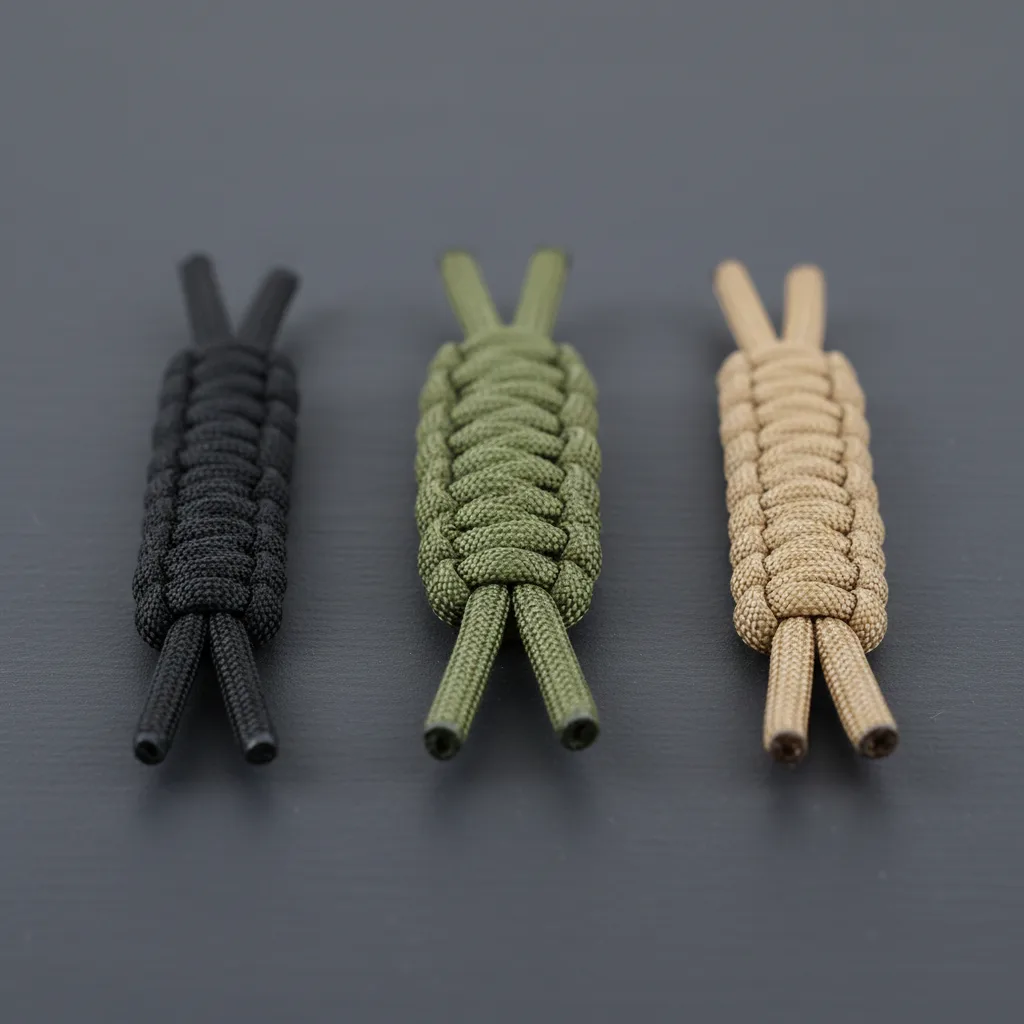
Cobra Weave (Solomon Bar)
The cobra weave is the dominant pattern in the survival bracelet market — a series of alternating half hitches worked around two core strands. The result is a flat, herringbone-like band roughly 3/4 inch wide that unravels in under a minute when you need the cord.
Construction
Two core strands run the length of the bracelet. A single working cord alternates left-over-right and right-over-left around these cores, creating interlocking loops. The result is a flat band approximately 3/4 inch (19mm) wide and 3-4mm thick.
Cord Usage
The cobra weave uses approximately 1 foot of paracord per inch of bracelet length. A standard 9-inch bracelet contains about 9 feet of cord. Bracelets like the Atomic Bear paracord bracelet (12ft) use longer cord runs with tighter weaving or extended tails to pack more material into the same wrist circumference. Our bracelet buying guide explains how cord length affects practical utility.
Pros
- Comfortable flat profile sits well under shirt cuffs and watch bands
- Fast to unravel — pull the free end and the entire weave comes undone in 30-60 seconds
- Good balance of cord density and wearability
- Attractive herringbone pattern available in every color and color combination
- The most widely used and best-understood weave — easy to re-weave if you need to. See the Atomic Bear vs ELK comparison for how different cobra weave tightness affects cord length and comfort
Cons
- Less cord capacity than king cobra or trilobite weaves
- Moderate thickness may still feel bulky for people used to thin wristbands
King Cobra (Double-Wide Cobra)
The king cobra is a cobra weave done twice — a standard cobra weave is completed, then a second layer of cobra weave is applied on top of the first, using the same or an additional cord. The result is a noticeably wider and thicker bracelet that holds 30-40% more cord than a standard cobra.
Construction
Start with a completed cobra weave bracelet. Using the remaining working cord (or a new cord), weave a second cobra pattern around the first one, treating the entire first bracelet as the core. This produces a band approximately 1 to 1.25 inches (25-32mm) wide and 6-8mm thick.
Cord Usage
A king cobra weave uses approximately 1.3-1.4 feet of cord per inch of bracelet length — roughly 30-40% more than a standard cobra. A 9-inch king cobra bracelet contains 12-13 feet of paracord. This makes it one of the best options when maximum cord storage is the priority.
Pros
- Holds up to 40% more cord than a standard cobra per bracelet
- Wider band distributes pressure across more wrist surface, reducing "digging in"
- Distinctive bold appearance that stands out from standard bracelets
- Unravels in two stages — outer layer first, then inner — so you can access cord incrementally
Cons
- Noticeably bulkier on the wrist — not ideal for all-day wear under long sleeves
- Heavier than standard cobra due to additional cord material
- Takes longer to unravel (two layers vs one) — not the fastest emergency deployment
- Harder to re-weave in the field without practice
Fishtail (Fishbone) Weave
The fishtail weave produces the slimmest, most elegant paracord bracelet. It is a narrower pattern that uses less cord per inch but creates a bracelet that looks more like a fashion accessory than a survival tool. The name comes from its resemblance to a fish skeleton when viewed from the side.
Construction
Two working cords loop around two core strands in a figure-eight pattern, with each cord passing through the loop of the previous one. The result is a narrow band approximately 1/2 inch (12-13mm) wide and 3-4mm thick — noticeably thinner than a cobra weave.
Cord Usage
The fishtail uses approximately 0.7-0.8 feet of cord per inch of bracelet length — about 25-30% less cord than a standard cobra weave. A 9-inch fishtail bracelet contains roughly 6-7 feet of paracord. This is a meaningful reduction in emergency cord capacity, which is why most survival-focused bracelets use the cobra weave instead.
Pros
- Thinnest and lightest common paracord weave — most comfortable for daily wear
- Subtle enough to wear in professional or casual settings without looking tactical
- Flexible and soft against skin, even during active movement
- Quick to unravel — simple pull-through construction
Cons
- Holds 25-30% less cord than a cobra weave — reduced survival utility
- Narrower band can feel like it "digs in" more under heavy wrist pressure
- Less common in commercially made survival bracelets — harder to find with tools
The ELK slim cobra bracelet uses a weave pattern that, combined with its one-handed clinch adjustment, creates the lightest and most comfortable bracelet in our catalog at under 1 ounce. While the ELK uses a cobra variant rather than a pure fishtail, its design philosophy aligns with the fishtail approach — prioritizing wearability over maximum cord storage.
Trilobite (Triple-Strand) Weave
The trilobite is the cord-packing champion. It uses three working cords woven around a core, producing a wide, dense bracelet that holds 50-60% more cord than a standard cobra weave. The name comes from its ridged, segmented appearance that resembles the ancient trilobite fossil.
Construction
Three separate cords are worked around two core strands in an interlocking pattern. Each cord takes a turn as the working cord while the other two are woven over and under. The result is a wide band approximately 1 to 1.5 inches (25-38mm) wide with a distinctive three-ridge surface texture.
Cord Usage
The trilobite uses approximately 1.5-1.6 feet of cord per inch of bracelet length — the highest cord density of any common weave. A 9-inch trilobite bracelet can contain 14-15 feet of paracord. This makes it the go-to weave for survivalists who want maximum cord capacity in a single bracelet.
Pros
- Maximum cord storage of any common weave — 50-60% more than cobra
- Distinctive appearance with a three-ridge texture
- Wide band distributes weight across more wrist surface
- Excellent for display pieces and custom bracelet projects
Cons
- Heaviest and bulkiest common weave — not practical for daily wear
- Complex three-cord construction takes 3-5 minutes to unravel
- Harder to re-weave in the field — requires experience with the three-cord pattern
- Rarely used in commercially made survival bracelets due to bulk
- The width can interfere with watch faces and shirt cuffs
How Weave Type Affects What Matters
Here is a side-by-side comparison of how each weave performs across the factors that matter for survival bracelet selection:
| Factor | Cobra | King Cobra | Fishtail | Trilobite |
|---|---|---|---|---|
| Cord per inch | ~1 ft | ~1.3-1.4 ft | ~0.7-0.8 ft | ~1.5-1.6 ft |
| 9" bracelet cord | ~9 ft | ~12-13 ft | ~6-7 ft | ~14-15 ft |
| Width | ~3/4" | ~1-1.25" | ~1/2" | ~1-1.5" |
| Comfort | Good | Fair | Excellent | Poor |
| Unravel speed | Fast | Moderate | Fast | Slow |
| Re-weave difficulty | Easy | Moderate | Easy | Hard |
| Commercial availability | Very common | Common | Uncommon | Rare (mostly DIY) |
For most buyers, the cobra weave is the right choice — it is the best balance of cord storage, comfort, emergency deployment speed, and commercial availability. The king cobra makes sense if you want more cord and do not mind the extra bulk. The fishtail is ideal for daily wear when you prioritize comfort over cord capacity.
Which Weaves Our Reviewed Products Use
The vast majority of commercially made survival bracelets use the cobra weave or a close variant. Here is what each product in our catalog uses:
- Atomic Bear cobra bracelet: Cobra weave with 12 feet of cord — achieves the highest cord length in our catalog through tighter weaving and extended cord runs within the standard cobra pattern.
- aZengear waterproof paracord bracelet: Cobra weave with 10.5 feet of waterproof-rated cord. Standard width and thickness.
- HR8 paracord survival bracelet: Cobra weave with 12 feet per bracelet. The button-snap closure integrates cleanly with the cobra pattern.
- ELK lightweight paracord bracelet: Slim cobra variant with 8 feet of cord. The tighter, narrower construction contributes to the under-1-ounce weight that makes it the lightest bracelet we tested.
- NexfinityOne and NVioAsport: Cobra weave with 10 feet per bracelet. The LED buckle assembly adds width at the clasp point but the weave body is standard cobra.
- Value packs (Smithok, RLXMARTD, Masajeset): All use standard cobra weave construction. Cord length varies from 9-10 feet per bracelet.
Frequently Asked Questions
What is the most common knot used in paracord bracelets?
The cobra weave (also called the Solomon bar) is the most common knot in commercially made paracord bracelets. It uses approximately 1 foot of cord per inch of bracelet length, creating a flat, comfortable band that is easy to unravel in an emergency. Nearly all bracelets in our catalog — including the <a href="/reviews/atomic-bear-paracord-bracelet/">Atomic Bear</a>, <a href="/reviews/azengear-paracord-bracelet/">aZengear</a>, <a href="/reviews/hr8-paracord-bracelet/">HR8</a>, and <a href="/reviews/elk-paracord-bracelet/">ELK</a> — use a cobra weave or close variation.
Which weave holds the most paracord?
The trilobite (triple-strand) weave packs the most cord into a bracelet, typically 50-60% more than a standard cobra weave. The king cobra (double cobra) is the next densest, using roughly 30-40% more cord than a standard cobra. If maximum cord capacity is your priority, look for bracelets marketed as "king cobra" or "wide" weave styles.
Is the Solomon bar the same as the cobra weave?
Yes. The Solomon bar and cobra weave are identical knots — just different names used by different communities. Macrame crafters and boaters call it the Solomon bar. The paracord and survival community calls it the cobra weave. The technique, cord usage, and appearance are exactly the same.
Can I unravel a cobra weave bracelet quickly in an emergency?
Yes. The cobra weave is one of the fastest weaves to unravel because it is essentially a series of alternating half hitches. Pull the free end from the buckle, and the entire weave comes undone in a continuous pull. Practice at home first — a well-made cobra weave bracelet unravels in 30-60 seconds once you know the technique.
Why are some bracelets thicker than others?
Thickness depends on the weave type and number of cord passes. A standard cobra weave is about 3/4 inch wide and relatively flat. A king cobra (double-wide) is about 1 to 1.25 inches wide and noticeably thicker. A fishtail weave is narrower — about 1/2 inch. Thicker weaves hold more cord but are bulkier on your wrist and may be less comfortable for daily wear.
Does the weave pattern affect cord strength?
The weave itself does not change the cord's rated breaking strength — that is a property of the paracord material. However, the weave affects how quickly you can access the full cord length and whether the cord comes out kinked or straight. Tighter weaves like the king cobra may produce more kinks when unraveled, which can create weak points if the cord is loaded immediately without straightening.
Which weave is most comfortable for everyday wear?
The fishtail (fishbone) weave is generally the most comfortable for daily wear because it produces the thinnest, most flexible bracelet. The standard cobra weave is a close second — flat enough to sit under a shirt cuff and flexible enough to not bind during wrist movement. King cobra and trilobite weaves are noticeably bulkier and can feel heavy for all-day use.
Choosing the Right Weave for Your Needs
The weave pattern matters, but it is one of many factors in choosing a survival bracelet. For most people, the cobra weave bracelets that dominate the market hit the sweet spot — enough cord for real survival utility, comfortable enough for daily wear, and fast enough to deploy in an emergency.
If cord capacity is your top priority, the Atomic Bear survival bracelet and HR8 cobra weave bracelet both pack 12 feet of 550lb cord into a standard cobra weave — the most in our catalog. If comfort matters most, the ELK slim cobra variant uses a slim cobra variant at under 1 ounce that you will forget you are wearing.
Whichever weave or bracelet you choose, the cord inside is what matters most. A well-made cobra bracelet with quality 550lb mil-spec paracord outperforms a king cobra bracelet with cheap, underspec cord every time.
Ready to Buy? Start Here
Based on this guide, our #1 recommendation:
Atomic Bear Paracord Bracelet Everyday carry and reliable all-around survival preparedness Read Full Review →Can’t Decide? Compare Side by Side
Paracord Reviews & Price Tracking
We track prices daily on every product we review. Updates only when something changes.
Only when something changes. Unsubscribe anytime.