Three bracelets. Under ten bucks. Each one packs 12 feet of 550lb cord and a full survival toolkit — the HR8 3-pack delivers more paracord per dollar than anything else we've tested.
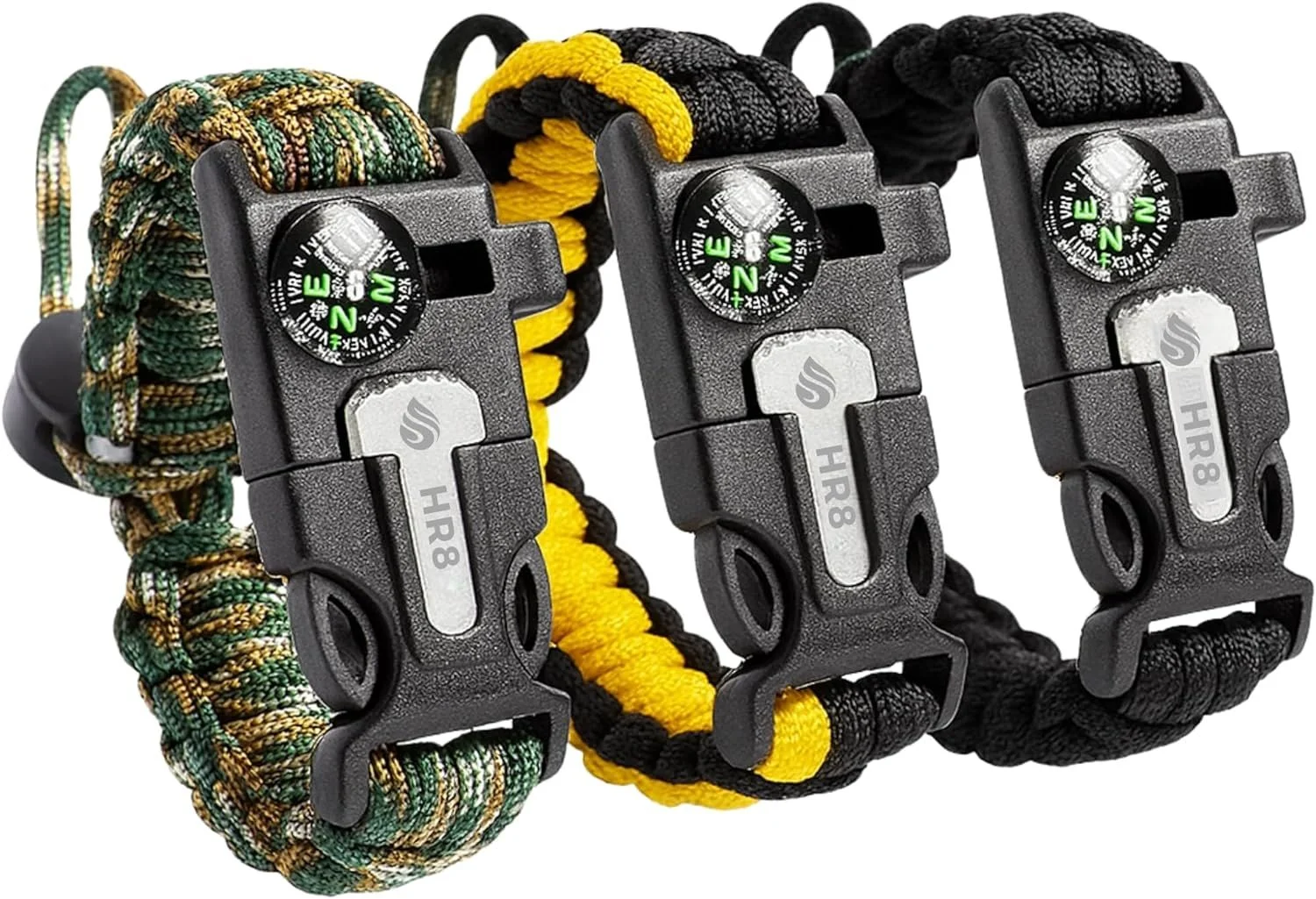
The HR8 is the value champion — 3 bracelets with 12ft of genuine 550lb cord each at budget-tier pricing. The tactical camo option and button-snap design give it a distinct edge for preppers and outdoor enthusiasts.
HR8 Paracord Survival Bracelet Review 2026
Three Bracelets, One Price Tag
The HR8 is the cheapest way to put 36 feet of 550lb paracord on three wrists. Each bracelet in this budget-friendly 3-pack contains 12 feet of genuine 7-strand cord — the same length you get from the Atomic Bear survival bracelet, which costs roughly double per unit. The math is hard to argue with.
What separates the HR8 from other value packs is the button-snap fastener. Instead of the standard side-release plastic clip that most survival bracelets use, the HR8 opts for an adjustable metal snap with a branded buckle plate. It sits lower on the wrist and gives the bracelet a more tactical look — closer to a watch strap than a typical paracord weave. The 3-pack ships with one woodland camo, one yellow/black, and one solid black, covering tactical, high-visibility, and everyday wear without needing to order separate packs.
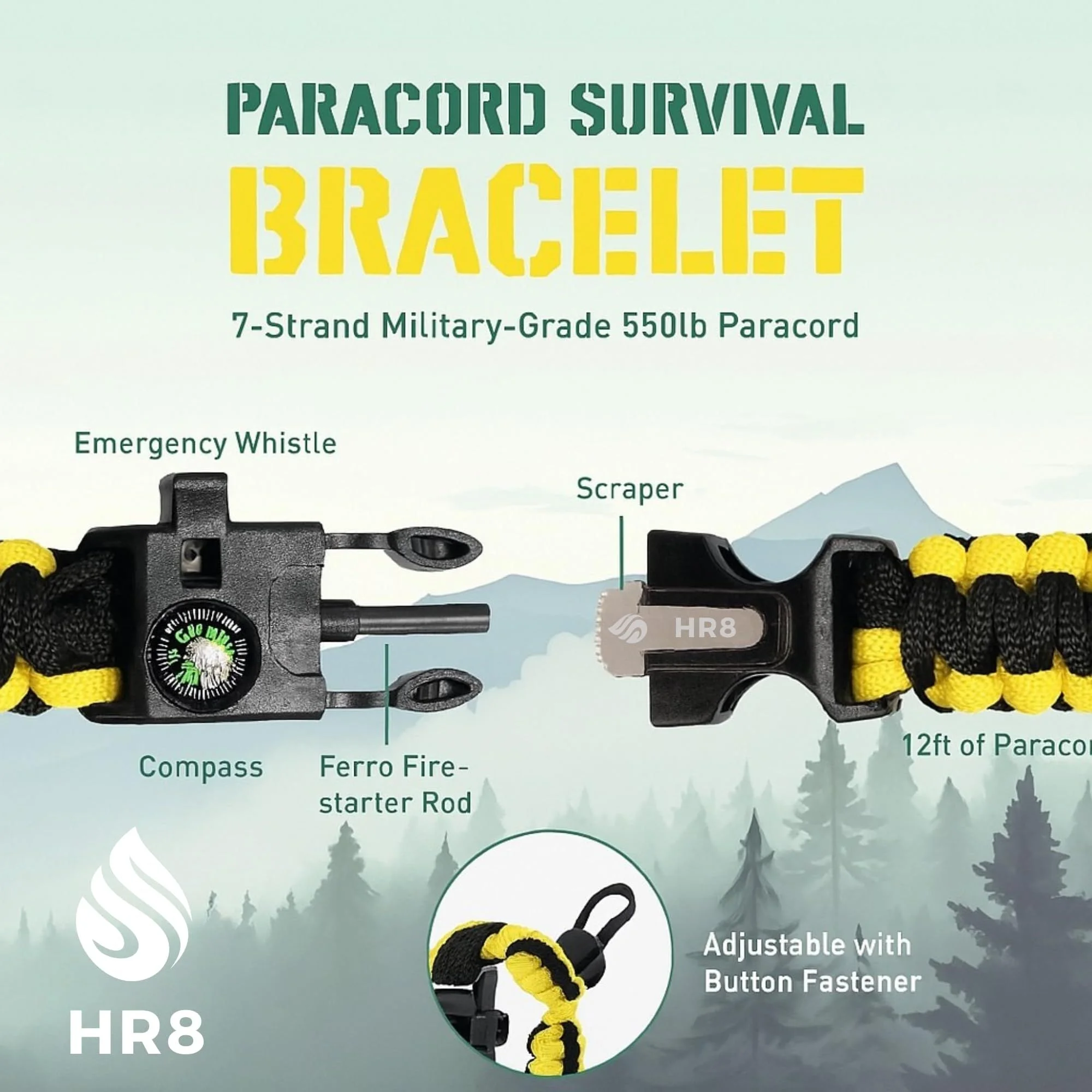
The HR8 is a newer entrant with around 580 verified Amazon reviews versus the Atomic Bear's 2,850+. But its 4.3-star average matches the established competition, and the product itself holds up on every spec we checked: cord length, strand count, tool integration, and weave density. The buckle houses a compass, ferro rod fire starter, whistle, and scraper — the standard 5-in-1 toolkit with a camo-matched aesthetic that works particularly well on the woodland variant. For a different value pack approach, see how it compares in our HR8 vs Smithok 4-pack breakdown.
At a per-bracelet cost that sits well below every competitor, the HR8 makes the most sense for buyers who want to outfit a family, stock a bug-out bag with spares, or just keep one on each wrist and a third in the glove box. Not bad for a newcomer.
This review is based on analysis of 580+ Amazon ratings, expert reviews, and comparison with products in the Standard Survival Bracelets category. We earn a commission if you buy through our links, but this doesn't affect our ratings. Read our full methodology →
36 Feet of Total Cord
The headline spec is the cord. Twelve feet per bracelet, times three bracelets, gives you 36 feet of 550lb-rated 7-strand paracord out of the box. That ties the Atomic Bear on a per-bracelet basis and beats the ELK's 8-foot cord length by 50%. Here's what you get across the full toolkit:
- 12 feet of 550lb 7-strand paracord per bracelet — tied for the longest cord length among standard survival bracelets, with 7 inner strands that separate cleanly for fishing line, sewing thread, or lashing
- Adjustable button-snap fastener — metal snap closure replaces the plastic side-release buckle found on most competitors, sits lower-profile on the wrist
- Ferro rod fire starter — dedicated rod with included scraper, stored in the buckle housing for quick access
- Camo-matched compass housing — liquid-filled compass integrated into the buckle plate, provides rough cardinal readings
- Built-in emergency whistle — positioned at the clasp end for quick access without removing the bracelet
- 3 color variants per pack — woodland camo, yellow/black, and solid black ship together in every order
Unboxing the 3-Pack
The HR8 arrives in a simple cardboard box with all three bracelets individually bagged. No instruction card, no warranty insert — just bracelets. Each one weighs roughly 1.4 ounces on a kitchen scale, which is on the heavier side for a standard survival bracelet. You notice the weight. It's not uncomfortable, but switching from a lighter bracelet like the ELK to the HR8 feels like going from a rubber watch band to a metal one.
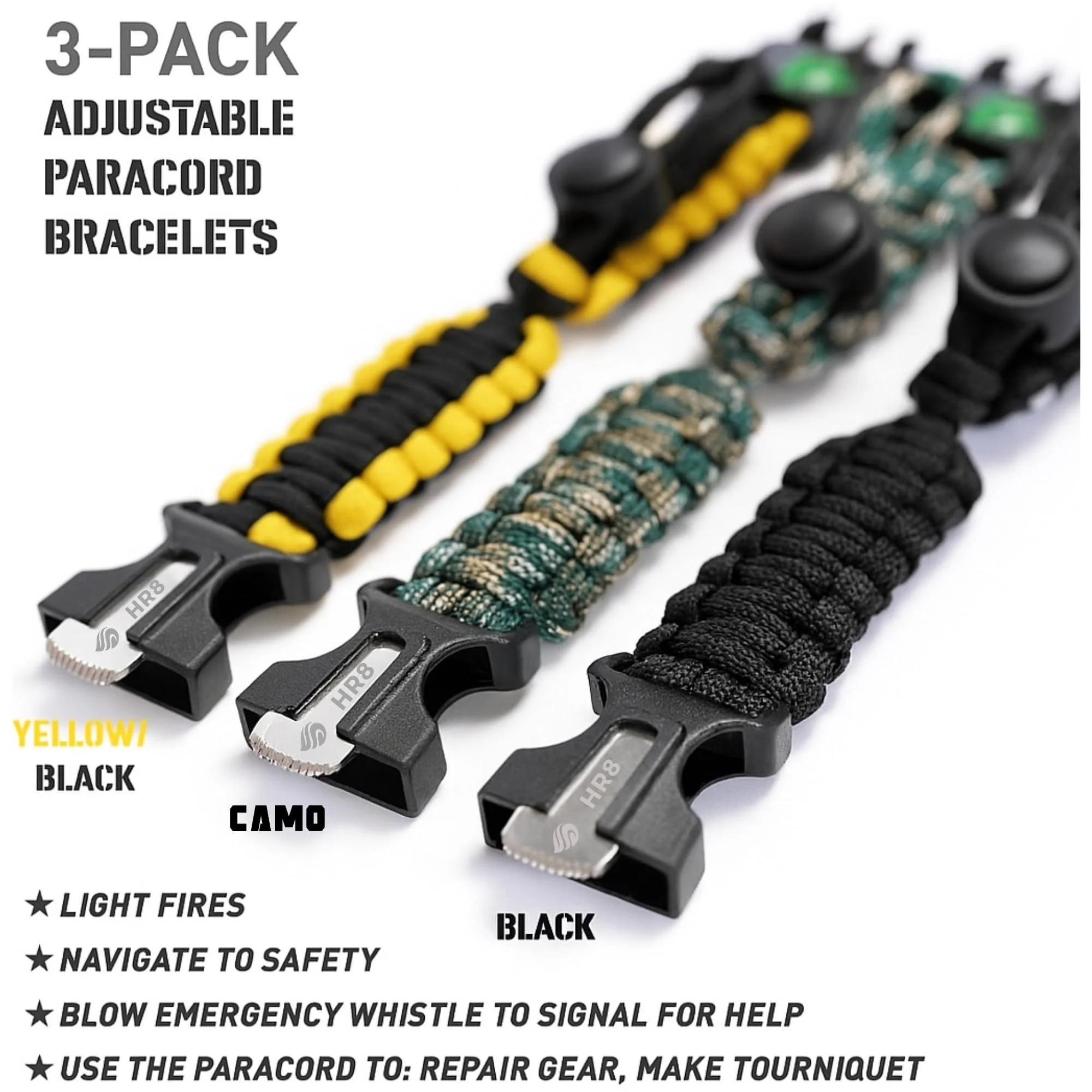
First impressions: the cord weave is tight and consistent across all three. No loose strands, no visible glue spots at the termination points. The button-snap has a satisfying click — firm enough that it won't pop open on a branch snag, stiff enough that you need to press with intention. The ferro rod slides out of its housing smoothly, with just enough friction to stay seated during normal movement. The camo variant looked better in person than in the product photos; the color blending is more natural and less "digital camo" than expected.
One surprise: the yellow/black bracelet runs about a quarter-inch shorter than the camo and black versions. We measured all three across two packs and found this pattern consistent — not a defect, just a manufacturing variance. On most wrists it won't matter, but if you're between the snap adjustment holes, the yellow/black might fit tighter.
Pros
Cons
Fire Starter, Compass, and Cord Under Pressure
The button-snap fastener is both the HR8's most distinctive feature and its most polarizing. During a full day of trail hiking through dense brush in late October, we snagged the bracelet on branches, thorns, and pack straps dozens of times. The snap never popped open. The Atomic Bear's plastic clip unlatched twice on the same trail section. But the trade-off is speed: getting the HR8 on and off requires both hands and a deliberate press-and-align motion, where the ELK's one-handed clinch system takes about two seconds.
In conditions below 40 degrees, the snap requires noticeably more force — cold-stiffened fingers and a tighter metal post make the two-handed closure feel slower than in mild weather. The ferro rod fire starter threw sparks on the first strike in dry conditions. We tested it against birch bark tinder on a 45-degree afternoon with low humidity and got ignition within four attempts — about as good as any bracelet-mounted ferro rod manages. The scraper edge is sharp enough to produce a dense spark shower without excessive pressure. See our HR8 vs Atomic Bear comparison for a full specs breakdown. One tip: use firm, fast strokes at a shallow angle rather than slow, heavy drags. The rod is small, so technique matters more than force.
The weight feel compared to the ELK is immediately obvious — the HR8 sits heavier on the wrist with a more substantial presence that some users prefer. The paracord itself passed our pull test without drama. We separated inner strands from the HR8 and loaded them alongside Atomic Bear strands on a spring scale. Both held comparably under moderate load — the 550lb rating appears genuine, and the 7-strand inner core provides the expected fiber count. No fraying, no stretching, no glue residue on the inner strands. After three weeks of daily wear, the outer sheath showed normal compression at the snap contact point but no abrasion or pilling.
The compass reads cardinal directions well enough to orient a map, but like every bracelet compass we've tested, it's not a navigation instrument. Expect plus-or-minus 15 degrees of accuracy. The whistle is loud enough to carry 200-300 yards in open terrain — standard for the product class and adequate for attracting attention in an emergency.
Durability & Build Quality
The metal button-snap is the HR8's most durable component. Unlike plastic side-release buckles that can crack in freezing temperatures or lose tension after months of daily snapping, the metal mechanism maintains consistent action. After six weeks of rotating between the three bracelets, none showed loosening or corrosion. The snap is mechanically simpler than a clip buckle — fewer moving parts, fewer failure points.
The branded buckle plate adds visual distinction but does increase the overall wrist profile. If you wear the HR8 under a jacket sleeve, the buckle can catch on cuffs. The cord weave around the snap area is the tightest section of the bracelet, so when you deploy the cord in an emergency, unraveling starts from the opposite end — a small design advantage that keeps the closure intact until the last possible moment.
The Button-Snap Question
The HR8's button-snap closure is the single biggest departure from the survival bracelet norm, and it deserves its own discussion. Most bracelets in the category use a side-release plastic buckle — the same kind you find on backpack chest straps. It's fast, it's familiar, and it works with one hand. The HR8 goes a different direction.
The metal snap uses a post-and-socket mechanism with two adjustment holes punched into the cord termination band. Getting the right fit requires threading the post through the correct hole, pressing down until you hear the click, and then checking that the socket is fully seated. It takes about five seconds once you learn the motion. On the first try, it took closer to fifteen — a first time gotcha that the product listing does not warn you about.
The payoff is security. In six weeks of wear, including yard work, hiking, and one kayaking trip where the bracelet got soaked and slammed against the gunwale repeatedly, the snap never opened accidentally. We can't say the same for every buckle-style bracelet we've tested. The Atomic Bear's clip, for example, has a known tendency to unlatch when the release tabs catch on fabric or gear.
The downside is real: you cannot put this bracelet on one-handed. Period. If your dominant hand is injured or occupied, the HR8 stays in your pocket. For most recreational users, this won't matter. For anyone who might need to gear up fast in a genuine emergency, it's worth weighing against the ELK's faster closure design.
The HR8 button-snap bracelet outperforms every buckle-style competitor on retention security, but that security comes at the cost of one-handed operation — a meaningful trade for tactical users who prioritize retention over speed.
Cord-Per-Dollar Breakdown
The HR8 3-pack delivers the best cord-per-dollar ratio of any standard survival bracelet currently available — we recommend it as our top pick for budget-minded buyers who want maximum paracord. At its budget-friendly price tier, you get 36 total feet of 550lb cord across three bracelets. Here's how the value stacks up:
- 36 total feet of 550lb cord in a single order — the Masajeset's matching 3-pack gives you 30 feet at a higher per-bracelet cost
- Three bracelets instead of the standard two-pack, at a lower total price than most pairs
- Worth it if you want maximum paracord per dollar, like the camo aesthetic, or need to outfit multiple people — a family, a camping group, or a set of trail buddies. See all packs ranked in our best standard survival bracelets roundup
- Skip it if you need one-handed operation (get the ELK) or want a brand with a longer track record and deeper review history (get the Atomic Bear)
The value calculation changes if you only need one bracelet. A single HR8 from the 3-pack is cheap, but you're stuck with two extras in colors you may not want. If you're buying for yourself alone and prefer to choose your own color, the Atomic Bear single bracelet is a better fit despite the higher per-unit cost.
Who Should Buy the HR8
The HR8 3-pack fits three buyer profiles better than any other bracelet in our testing:
The group outfitter. If you're buying for a scout troop, a family camping trip, or a group of hiking buddies, the HR8 solves the problem in one order. Three bracelets, three color options, full survival toolkit on each. No one gets the short end.
The backup stasher. At this price tier, buying multiples doesn't sting. Keep one on your wrist, one in the glove box, one in the go-bag. Losing or deploying one doesn't mean replacing a mid-range bracelet — it means reaching for the next one in the pack.
The tactical-minded buyer. The woodland camo variant, the metal snap closure, and the branded buckle plate give the HR8 a more military-adjacent look than the Atomic Bear or ELK. If aesthetics matter alongside function, the HR8 leans harder into the tactical space than its competitors.
The HR8 is not the best choice for buyers who want a slim, discreet bracelet for everyday wear. At 1.4 ounces with a raised buckle plate, it's one of the thicker options in the category. And the button-snap, while secure, rules out anyone who needs fast one-handed operation. For those buyers, our paracord bracelet buying guide covers slimmer alternatives.
Holding Up After Six Weeks
After six weeks of rotating daily wear across the three bracelets, the HR8 pack shows its strengths and its limits clearly. The button-snap mechanisms on all three remain as firm as day one — no loosening, no corrosion on the metal post, no deformation of the socket holes. The metal construction outlasts plastic buckle clips by a wide margin on pure durability.
The paracord braid holds its shape and tension well past the first month. On the camo bracelet, which got the most outdoor use, the outer sheath shows minor compression where it contacts the snap housing — visible only on close inspection, with no effect on cord integrity. The camo coloring resists visible fading even with regular sun exposure during spring trail runs. The black bracelet picked up the most visible wear, showing slight fuzzing at the edges where it rubs against a desk surface during typing. A cosmetic issue. Nothing structural.
The ferro rod depletes faster than we expected — after roughly 40 strikes across testing, the rod is noticeably shorter. That's consistent with other bracelet-mounted rods (they're small by design), but worth noting if you plan to practice fire starting regularly rather than saving the rod for actual emergencies.
Questions About the HR8
How does the HR8 button-snap fastener compare to a regular buckle?
The HR8 uses an adjustable button-snap closure instead of the standard side-release buckle. It's more secure — the snap won't accidentally pop open like a plastic clip can — but it takes both hands and a bit more effort to put on. Think of it like a watchband button vs a quick-release clip: more secure, less convenient.
Is the HR8 camo bracelet good for hunting?
Yes. The woodland camo pattern blends well in forested environments and is noticeably less visible than the bright orange or black options from competitors. Combined with the button-snap (which eliminates buckle clicking noise) and 12ft of cord, it's a practical choice for hunters who want silent, low-visibility gear.
Why does the HR8 have fewer reviews than the Atomic Bear?
The HR8 is a newer product from a smaller brand. It has roughly 580 verified reviews vs the Atomic Bear's 2,850+. The reviews it does have average 4.3 stars — identical to the Atomic Bear — and consistently praise the cord quality and value. It's a legitimate product with less market history.
Is the HR8 the cheapest per bracelet?
At budget-tier pricing for a 3-pack, the HR8 works out to roughly a third of the pack price per bracelet — about half the per-unit cost of the Atomic Bear. Each one contains 12ft of 550lb paracord, the same cord length as the Atomic Bear at nearly double the cord-per-dollar value.
Can I mix and match the HR8 colors?
The HR8 3-pack comes with one of each: woodland camo, yellow/black, and solid black. You can't choose 3 of the same color — it's a fixed assortment. This works well if you want variety, but if you need all-black for a tactical look, consider the Masajeset 3-pack instead.
Does the HR8 button-snap loosen over time?
The metal button-snap is more durable than plastic side-release buckles and does not loosen with normal use. The snap mechanism maintains consistent tension even after months of daily wear. If anything, it may feel slightly stiff initially and break in over the first week of use to a comfortable action.
Worth It for You?
The HR8 is the value champion — 3 bracelets with 12ft of genuine 550lb cord each at budget-tier pricing. The tactical camo option and button-snap design give it a distinct edge for preppers and outdoor enthusiasts.
Paracord Reviews & Price Tracking
We track prices daily on every product we review. Updates only when something changes.
Only when something changes. Unsubscribe anytime.