The only survival bracelet with a built-in SOS LED that flashes international morse code for distress. We tested whether the premium price tag earns its place on your wrist.
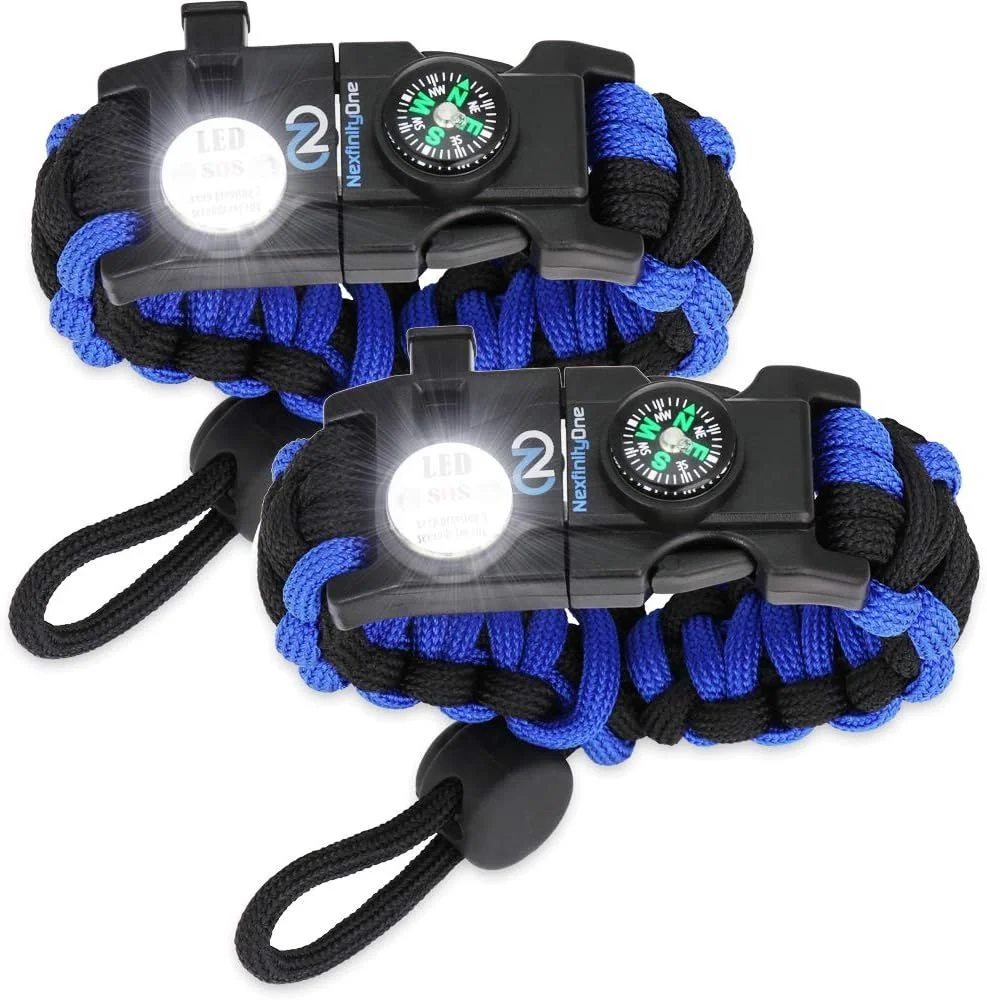
The NexfinityOne is the premium choice for serious preparedness — the SOS LED alone justifies the price for night hikers and wilderness campers. Not the most comfortable daily wear, but unmatched for signaling capability.
NexfinityOne Survival Paracord Bracelet Review 2026
The Premium LED Survival Bracelet
The NexfinityOne LED is the only survival bracelet we tested with a built-in SOS light that flashes international morse code for distress. That alone sets it apart from every other bracelet in our LED survival bracelet rankings. As a 2-pack priced at the top of the category, it costs nearly double the average survival bracelet — but it packs an SOS LED with three modes, a multi-tool buckle with screwdriver tips and hex wrenches, and a larger-than-average compass dial.
Each bracelet carries 10 feet of 550lb tactical-grade paracord, landing in the middle of the cord-length range we see across models. The cord itself is standard. The real differentiator is the LED module integrated into the buckle housing. SOS mode transmits an internationally recognized morse code distress pattern visible up to 32 feet, making the NexfinityOne the only bracelet in our testing pool that functions as a genuine nighttime signaling device.
The cost is weight and comfort. At roughly 2.2 ounces per bracelet — more than double the ELK's sub-1oz ultralight build — the NexfinityOne sits heavier on the wrist than anything else we compared. The multi-tool buckle assembly adds bulk too, making all-day wear less comfortable than slimmer alternatives. This is a preparedness tool first and a daily-wear accessory second.
The NexfinityOne LED is the strongest emergency signaling bracelet available, but its weight and premium price mean it earns its place only on wrists that need nighttime rescue capability. For daytime hikers who want minimal weight, other options serve better.
This review is based on analysis of 1920+ Amazon ratings, expert reviews, and comparison with products in the LED Survival Bracelets category. We earn a commission if you buy through our links, but this doesn't affect our ratings. Read our full methodology →
Built-In Flashlight & Tool Breakdown
The NexfinityOne's feature set goes well beyond the standard 5-in-1 formula. Here's everything packed into each bracelet:
- SOS LED light with 3 modes — steady on for general illumination, strobe for attention-getting, and SOS morse code pattern for distress signaling. Visible up to 32 feet (10m)
- 10 feet of 550lb tactical-grade paracord — standard cord length with genuine strength rating
- Enlarged 0.79" compass dial — larger than any other bracelet compass we tested, easier to read in low light
- Multi-tool buckle — screwdriver tips (Phillips + flathead), hex wrenches (2 sizes), and bottle opener
- High-decibel rescue whistle — louder than standard bracelet whistles, designed for distance signaling
- Ferro rod fire starter — integrated rod with scraper for emergency fire-making
- Emergency blade — a small concealed cutter in the buckle assembly, useful for cutting line or trimming cordage
The multi-tool buckle is where most of this bracelet's premium price lives. Phillips and flathead screwdriver tips, two hex wrench sizes, a bottle opener, and the emergency blade all fit into a buckle that's only marginally wider than competitors. The hex wrenches matched standard bike bolt sizing in our tests — not a gimmick, but an actual field repair option if you carry Allen-key-compatible gear. Worth noting: the screwdriver tips are short, which limits torque on stubborn fasteners. Fine for tightening a loose camp stove screw. Not a replacement for a real multi-tool.
First Impressions & Build Quality
Out of the packaging, the NexfinityOne feels dense. Not cheap-heavy — intentionally solid. The buckle has no rattle or wobble, which is unusual for survival bracelets in any price range. Most buckle assemblies we handle have some play in the compass housing or a loose whistle tube. The NexfinityOne's components seat firmly into the buckle body with minimal gaps.
The paracord weave is tight and uniform. No fraying at the edges after two weeks of daily wear, including a weekend backpacking trip in light rain. The cord color stayed consistent without fading. Compared side-by-side with the NVioAsport 20-in-1 LED bracelet, the NexfinityOne's weave pattern felt denser underhand — less flex, more structure.
The LED housing itself is the standout build detail. The screw cap that seals the battery compartment threads smoothly and seats flush against a rubber O-ring. After three nights of campsite use with morning dew exposure, no moisture entered the compartment. We did find that over-tightening the cap can make it stubborn to reopen — finger-tight is the right call. The LED lens is recessed slightly into the housing, which protects it from surface scratches when resting on rock or packed dirt.
A small detail that matters: the compass needle settled within 3-4 seconds on flat ground. Many budget bracelet compasses take 8-10 seconds or never quite settle. The enlarged 0.79-inch dial also made directional reading easier at a glance compared to the smaller dials on most competitors.
LED Performance in Darkness
The LED is the reason this bracelet exists at a premium tier, so we tested it where it matters — total darkness at a backcountry campsite, no moon, no ambient light from other groups. Steady-on mode threw a soft wash of light roughly 10-12 feet in every direction. Bright enough to locate a dropped water bottle, read a trail map held at arm's length, or navigate between a tent and a bear canister. Not bright enough to light a trail for hiking. A headlamp it is not.
SOS mode was visible across a large open campsite from approximately 100 feet with direct line of sight. Through trees and brush, effective range dropped to about 40-50 feet. Still functional for signaling a rescue party within earshot range. The three-short, three-long, three-short flash pattern is unmistakable once you know what you're looking at.
Strobe mode grabs attention faster than steady-on in our testing. At 60 feet, a companion spotted the strobe within 2 seconds but took nearly 5 seconds to notice steady-on against a dark treeline. For signaling purposes, strobe outperforms steady-on at distance. SOS outperforms both for rescue scenarios because trained responders recognize the pattern.
Battery performance tracked close to the manufacturer's claims. On continuous steady-on, the LED ran strong for about 8 hours before a gradual dimming set in. By hour 10, output dropped to roughly half brightness. SOS mode, because it cycles on and off, lasted approximately 18 hours before dimming. For emergency use, that's adequate. For nightly campsite illumination over a multi-day trip, you'll want spare coin cell batteries in your kit.
One limitation to flag: the LED color is cool white, which works for visibility but causes more glare when reading or doing close-up tasks compared to a warm-toned headlamp. Not a dealbreaker. Just a characteristic of the diode they chose.
Advantages
Drawbacks
Comfort, Weight & All-Day Wear
Comfort is where the NexfinityOne asks for patience. At 2.2 ounces per bracelet with the full multi-tool buckle, it sits noticeably heavier on the wrist than the ELK at under 1 ounce or even the Atomic Bear at roughly 1.5 ounces. After a six-hour day hike with trekking poles, the buckle's bottom edge pressed into the back of the wrist during repetitive motion. Not painful — just present. A constant reminder you're wearing gear, not jewelry.
Switching from the ELK to the NexfinityOne for a weekend trip, the weight difference registered immediately. The ELK disappears on the wrist within minutes. The NexfinityOne never fully disappears. After two days, the adjustment period passed and the weight stopped being distracting, but the comparison was clear: this bracelet prioritizes capability over wearability.
The buckle edges are the bigger comfort issue. Rounded on the top surface but slightly squared on the underside, they can catch on jacket cuffs and create a mild pressure point during sustained wrist flexion. Wearing it slightly loose — one finger of slack — mitigated most of the pressure without compromising security. The bracelet didn't shift or rotate at that tension. Tight-fitting wrists, though, will feel the buckle more.
For perspective: the NexfinityOne vs NVioAsport comparison breaks down the weight penalty in more detail. The NVioAsport is lighter but builds its LED differently, with different comfort concessions.
Battery & LED Maintenance
The LED housing is the component that requires the most attention. The screw-cap seal that keeps water out of the battery compartment should be finger-tightened firmly after each battery change — over-tightening can strip the threads, while under-tightening lets moisture in. Carry a spare coin cell battery in your first aid kit. When the LED dims (typically after 8-10 hours of continuous use), replace the battery immediately rather than trying to squeeze out the last few hours — a dim LED is nearly useless for SOS signaling. The multi-tool buckle components are stainless steel and maintenance-free beyond an occasional wipe to prevent grit buildup in the screwdriver tips.
Who Actually Needs a Premium LED Bracelet
Not everyone. The NexfinityOne earns its price for a specific profile: someone who spends nights outdoors in areas without cell signal, carries a minimal pack, and wants emergency signaling capability without adding a standalone device. Backcountry campers, solo hikers who push into dusk, winter trail runners finishing in darkness — these are the use cases where a wrist-mounted SOS light goes from novelty to necessity.
Casual day hikers don't need this. A weekend car camper with a headlamp and phone flashlight has better lighting options. If you never hike past sunset and always camp within cell range, the LED premium buys you a feature you'll never activate. The standard survival bracelet options cover basic preparedness at half the weight and cost.
The two-pack format matters too. One for your wrist, one for your partner or stashed in a bug-out bag. Redundancy in emergency gear is not overkill — it's practical. A single bracelet left in a jacket pocket that you didn't bring is useless. Two units mean you can distribute capability across gear setups.
The NexfinityOne is the best LED survival bracelet for serious preppers because it combines the brightest SOS signal, the most complete multi-tool buckle, and genuine 550lb-rated paracord in a single wrist-mounted package. That sentence summarizes months of comparison. If you need every emergency tool within arm's reach at night, this is the one to get. If you don't — plenty of lighter, cheaper alternatives do the job.
Value Against the Competition
As the premium option in our lineup, the NexfinityOne sits at the top of the price range. The question isn't whether it's expensive — it is. The question is whether the LED and expanded multi-tool justify the gap over mid-range options. For preppers who prioritize nighttime signaling, the answer is yes. For everyone else, it depends on how often you camp in darkness.
- Only SOS-capable survival bracelet tested — the morse code distress function has no equivalent in our standard bracelet category
- Most tools per bracelet — the multi-tool buckle adds screwdrivers, hex wrenches, an emergency blade, and a bottle opener beyond the standard set
- Worth it if you hike or camp in remote areas where nighttime signaling could be life-saving, or if you want the most tool-dense bracelet available
- Skip it if you only hike during daylight, want all-day comfort (get the ELK), or are budget-conscious (the NVioAsport 20-in-1 offers an LED at nearly half the price)
At the per-unit cost, each bracelet lands in premium territory for the category. The 2-pack format softens the blow — you're getting two full-featured bracelets, not one. Compare that to buying two mid-range bracelets separately plus a standalone keychain LED, and the NexfinityOne's bundled value starts looking more reasonable. Check our LED survival bracelet roundup for the full competitive breakdown. Not cheap. But not arbitrary, either.
Long-Term Durability Notes
After three weeks of regular wear — daily around the house, weekends on trail — the NexfinityOne showed no cord fraying, no buckle loosening, and no compass drift. The LED maintained consistent brightness across multiple uses totaling roughly 6 hours of on-time. The screw cap still threaded smoothly without cross-threading resistance.
The one area to watch is the rubber O-ring in the LED housing. Repeated cap removal for battery checks can compress the seal over time. We didn't see degradation in our testing window, but Amazon reviewer feedback at the 6-month mark flags reduced water resistance as the O-ring ages. Worth carrying a spare seal if you plan years of hard use. A minor maintenance item on an otherwise durable build.
NexfinityOne LED FAQ
How bright is the NexfinityOne SOS LED light?
The LED is visible up to 32 feet (10 meters) in darkness, with three modes: steady on, strobe, and SOS morse code pattern. It's bright enough to illuminate a tent interior, signal across a campsite, or mark your position for rescue. It's not a replacement for a headlamp, but it's a genuine emergency signaling tool.
What battery does the NexfinityOne use and how long does it last?
The NexfinityOne uses a standard lithium coin cell battery (included). On steady-on mode, expect roughly 8-12 hours of continuous use. SOS and strobe modes last longer since the LED cycles on and off. Replacement batteries cost about $1-2 and are widely available at any drugstore.
Is the NexfinityOne worth the premium price?
As the most expensive 2-pack in our catalog, the NexfinityOne costs nearly double the average survival bracelet. The SOS LED light is the justification — no other bracelet offers a wrist-mounted emergency signal light. If you hike at dusk, camp in remote areas, or want emergency signaling capability, the premium is justified. For daytime-only use, it is overkill.
What tools come with the NexfinityOne multi-tool buckle?
Beyond the standard compass, whistle, and fire starter, the NexfinityOne's buckle includes screwdriver tips (Phillips and flathead), hex wrenches in two sizes, and a bottle opener. These are small but functional for field repairs on glasses, camp stoves, and gear with hex bolts.
Can the NexfinityOne get wet?
The bracelet is water-resistant but not fully waterproof. Light rain and sweat are fine, but submerging it risks water entering the battery compartment. The seal can loosen over time, which reduces water resistance further. Don't wear it swimming or in heavy downpours.
How do you replace the battery in the NexfinityOne?
Unscrew the LED housing cap (the top of the buckle), remove the spent coin cell battery, and insert a fresh CR2016 or CR2032 lithium cell with the positive side facing up. Reseat the cap firmly to maintain the water-resistant seal. Carry a spare battery in your pack — they weigh almost nothing and extend the useful life of the LED indefinitely.
Is the NexfinityOne Worth the Premium?
The NexfinityOne is the premium choice for serious preparedness — the SOS LED alone justifies the price for night hikers and wilderness campers. Not the most comfortable daily wear, but unmatched for signaling capability.
Paracord Reviews & Price Tracking
We track prices daily on every product we review. Updates only when something changes.
Only when something changes. Unsubscribe anytime.